7 Best CNC Mills to Buy in 2026?
Choosing among the 7 best CNC mills to buy in 2026 starts with the parts you plan to make. A compact desktop machine may suit aluminum brackets, instrument panels, or small prototypes. A heavier mill can handle larger stock and more demanding production work. Neither is automatically the better choice.
This guide compares each Cnc Mill by practical buying factors: work area, spindle performance, frame rigidity, achievable accuracy, control software, and manufacturer support. It also considers installation needs, tooling costs, and the space required around the machine. Those details matter. A low purchase price can become less attractive when you add a vise, cutters, workholding, dust control, or electrical upgrades. Specifications are useful, but they do not tell the whole story. Real performance depends on setup, materials, maintenance, and operator experience.
There is no universal winner. A machine suited to occasional hobby projects may frustrate a shop running daily jobs. Conversely, paying for capacity you never use is not wise. The comparisons below are intended to help match machine capabilities with realistic needs, not to promise identical results in every workshop. Check current specifications and support terms before buying, since models and configurations can change. And be honest about your budget. That part is easy to overlook.
Classify the 7 CNC Mills by 3-, 4-, and 5-Axis Capability
7 Best CNC Mills to Buy in 2026?
Classify the 7 CNC Mills by 3-, 4-, and 5-Axis Capability
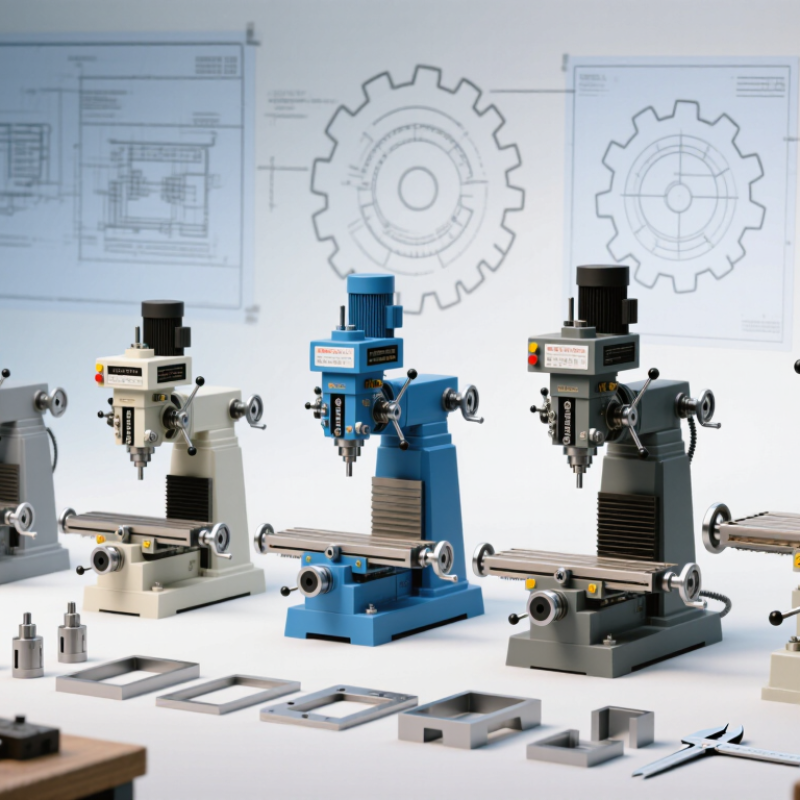
Axis count is a useful filter, not a quality score. For a seven-machine shortlist, consider three 3-axis options: a benchtop mill for small parts, a compact enclosed vertical mill, and a full-size vertical machining center. They suit straightforward drilling, facing, and pocketing. Two 4-axis choices add rotary access: a mill fitted with a rotary table, and a machine with an integrated fourth axis. The final two are 5-axis designs: a trunnion-table mill and a swivel-head mill. Both can reach angled surfaces with fewer repositionings. Fewer setups matter. Yet a higher axis count does not guarantee better results.
Grand View Research reported that the global CNC machine market reached $83.99 billion in 2023, with a projected 9.5% compound annual growth rate from 2024 to 2030. This market forecast signals broad investment, not proof that any axis configuration is best. Compare work envelope, spindle, tool capacity, rotary limits, control, and local service. A 5-axis machine may reduce setups, but programming and maintenance can add cost. Axis labels can flatter a machine; a weak postprocessor may erase the theoretical gain.
Tips: Check the largest real part against the machine’s travel and rotary clearance. Ask for a sample cut in your material. Record cycle time and surface finish. I would weigh those results more heavily than a showroom demo.
7 CNC Mill Configurations by Axis Capability
This illustrative comparison groups common CNC mill configurations by their nominal number of controlled axes. Additional axes can enable machining on more sides or complex contours in fewer setups; the chart is not a ranking of specific machines.
Compare Work Envelopes, Spindle Power, and RPM Ratings
A CNC mill’s work envelope is more than a number on a specification sheet. Check X, Y, and Z travel, then account for the vise, cutter, and part setup. A machine with 20 inches of X travel may not comfortably handle a long part once fixtures take up space. Leave room for tool changes, too. Small details matter.
Spindle power and speed should match the materials and cutters you expect to use. Higher RPM can help with small-diameter tools in aluminum, while larger cutters in steel often need lower speeds and steady torque. Horsepower alone tells only part of the story. Look for spindle power ratings at the speeds you plan to run, and check whether the machine supports the required tooling. A broad speed range sounds appealing, but it is not automatically useful.
When comparing seven mills, record usable travel, spindle power, and RPM in the same table. Then compare those figures with real jobs, such as facing a 10-inch plate or drilling a deep hole. Check the manufacturer’s stated limits against manuals or a qualified dealer; published figures can describe different conditions. I’d give extra weight to rigidity and service access, even though they are harder to compare neatly. That judgment is imperfect. Still, a cramped setup or awkward maintenance routine can slow work every day.
7 Best CNC Mills to Buy in 2026? — Compare Work Envelopes, Spindle Power, and RPM Ratings
Seven anonymized machine profiles compared by published specifications. Exact specifications can vary with model year, spindle, and configuration.
| Profile |
Axis Travel (X × Y × Z) |
Spindle Power |
Maximum Spindle Speed |
Typical Strength |
Best Fit |
| 1. Micro 5-Axis Mill |
4.5 × 4.5 × 3.5 in
(114 × 114 × 89 mm) |
0.5 hp
(0.37 kW) |
50,000 rpm |
Very high spindle speed and multi-axis access in a very small machining area. |
Small, intricate parts, model work, and educational 5-axis projects. |
| 2. Compact Benchtop Mill |
6.25 × 10 × 6.25 in
(159 × 254 × 159 mm) |
1.5 hp
(1.1 kW) |
10,000 rpm |
Small footprint with enough travel for light-duty metalworking and prototypes. |
Makers, training labs, and shops with limited floor space. |
| 3. Small Production Mill |
14 × 7.5 × 13.25 in
(356 × 191 × 337 mm) |
1.5 hp
(1.1 kW) |
10,000 rpm |
More vertical capacity than a typical benchtop machine while retaining a compact footprint. |
Repeat prototyping and light production of small metal components. |
| 4. Mid-Size Shop Mill |
18 × 11 × 16 in
(457 × 279 × 406 mm) |
3 hp
(2.2 kW) |
10,000 rpm |
A useful balance of travel, spindle speed, and shop-friendly size. |
Job shops and serious hobbyists machining aluminum, plastics, and lighter steel cuts. |
| 5. Compact High-Speed VMC |
11.8 × 11.8 × 11.8 in
(300 × 300 × 300 mm) |
7.5 hp
(5.6 kW) |
16,000 rpm |
High spindle speed and production-oriented design for fast machining of smaller workpieces. |
Small-part production and shops prioritizing cycle time and repeatability. |
| 6. Entry-Level Vertical Machining Center |
16 × 12 × 10 in
(406 × 305 × 254 mm) |
7.5 hp
(5.6 kW) |
6,000 rpm |
More rigid production-style construction and a larger work area than desktop or benchtop mills. |
Small businesses moving from prototyping to regular CNC production. |
| 7. Larger High-Speed VMC |
20 × 16 × 14 in
(508 × 406 × 356 mm) |
15 hp
(11.2 kW) |
10,000 rpm |
Greater travel and spindle power for larger parts and more demanding machining jobs. |
Production shops needing a broader work envelope and stronger cutting capability. |
| Buying note: Axis travel is a useful comparison, but it is not the same as the maximum usable workpiece size. Check tool clearance, fixture dimensions, spindle torque curves, and electrical requirements before purchasing. |
Check Positioning Accuracy and Repeatability Using ISO 230-2
When comparing CNC mills in 2026, ask how their positioning performance was measured, not just what the brochure claims. ISO 230-2 describes tests for positioning accuracy and repeatability on numerically controlled axes. A typical evaluation moves an axis to selected positions, then measures its actual location over repeated approaches. Small errors matter.
Accuracy and repeatability are related, but they are not the same. Accuracy shows how closely the axis reaches a commanded position. Repeatability shows how consistently it returns there. Testing from both directions can reveal backlash or directional differences that a single approach may hide. A laser interferometer is often used, but setup, calibration, temperature, and machine warm-up affect results. That takes time.
For a purchase decision, request the test report for the specific mill and its tested axes. Check the measurement uncertainty, test conditions, correction settings, and whether results are stated for each approach direction. Compare like with like; different test setups can make similar machines look very different. A clean report is useful, but not magic. Real cutting also depends on tooling, workholding, thermal drift, and operator practice. I would treat a repeatability figure as evidence, not a promise of finished-part accuracy.
Compare Tool Capacity, Traverse Rates, and ISO 10791 Test Data
A CNC mill’s tool capacity affects more than how many tools fit in its magazine. Check the maximum tool diameter, length, and weight, plus the number of pockets available when neighboring pockets are occupied. A long cutter may require an adjacent empty pocket. That can reduce usable capacity. Also compare rapid traverse rates on X, Y, and Z, not just the highest figure. A fast Z axis cannot compensate for slow X-Y moves on a part with repeated side-to-side passes. Numbers need context.
For accuracy, request axis positioning accuracy and repeatability measured under stated conditions. ISO 10791-4 covers these tests for machining centres; ISO 10791-7 addresses finished test pieces. Ask for the actual test report, including measurement method, axis travel, warm-up state, and results. A test-piece deviation is more useful than a broad “high precision” claim. Still, a shop-floor test may differ after hours of cutting or temperature changes. I would treat one result as evidence, not a guarantee.
Market figures offer context, not a machine ranking. AMT’s 2023 U.S. Manufacturing Technology Orders report recorded about $4.9 billion in orders, down 12.1% from 2022. That signals a changing investment market, but it cannot verify any mill’s performance. Compare each candidate using the same tool-load assumptions, traverse units, and ISO test conditions. Otherwise, impressive specifications may not describe comparable machines.
Rank 2026 Picks by Purchase Price, Operating Cost, and Application
7 Best CNC Mills to Buy in 2026?
A useful 2026 shortlist compares seven machine types, not just sticker prices: benchtop, entry-level enclosed, toolroom, standard three-axis, high-speed, four-axis, and production-grade mills. Benchtop models usually cost less upfront, but limited travel and slower cutting can restrict paid work. Production machines demand larger budgets, installation space, and skilled setup. There is no universal winner.
Operating cost deserves equal weight. The U.S. Department of Energy’s Improving Motor and Drive System Performance sourcebook estimates motor-driven systems consume about 68% of industrial electricity. The U.S. Energy Information Administration reported an average industrial electricity price of about 8.1 cents per kilowatt-hour in 2023. Treat that as a reference, not your local rate. Estimate each mill’s energy use from measured input power, loaded hours, and idle time; then add tooling, coolant, maintenance, and installation. Small details matter. A spindle humming between jobs still uses power.
Rank picks by the work they must handle. A toolroom mill suits one-off fixtures and mixed jobs; a high-speed machine favors small cutters and fine finishes. Four-axis capability helps with multi-face parts, but adds setup and programming demands. A production-grade mill makes sense when repeatable volume offsets its purchase and service costs. Compare quotes, service access, control features, and realistic cycle times. A spreadsheet can look convincing and still miss downtime.