
Choosing among China’s best Multi Stage Cylinder manufacturers calls for more than comparing prices or catalog photographs. Buyers should examine engineering capability, materials, testing records, customization options, and after-sales support. A cylinder may look robust on a screen, yet still struggle with side loads, uneven extension, or repeated duty cycles. Details matter.
For transparency, the following quotation is editorially created, not a verified public statement. It is attributed to a fictional composite specialist, hydraulic design engineer Lin Wei: “A reliable Multi Stage Cylinder must extend smoothly under real load, not just look precise on a drawing.” That is the practical test. Ask manufacturers how they control tube alignment, sealing, surface finish, and stage sequencing. Request relevant test data, dimensional drawings, and references for comparable equipment. Check whether the supplier can explain its design choices in plain language. A polished brochure is useful, but not enough.
This guide explores manufacturer capabilities, product quality, customization, lead times, and service considerations. It also looks at where supplier claims deserve closer scrutiny. Some details can be difficult to verify remotely. A factory visit or independent inspection may help, when practical. The strongest choice is not automatically the largest or cheapest supplier. It is the one that can show how its cylinder performs in conditions close to yours—and acknowledge what still needs testing.
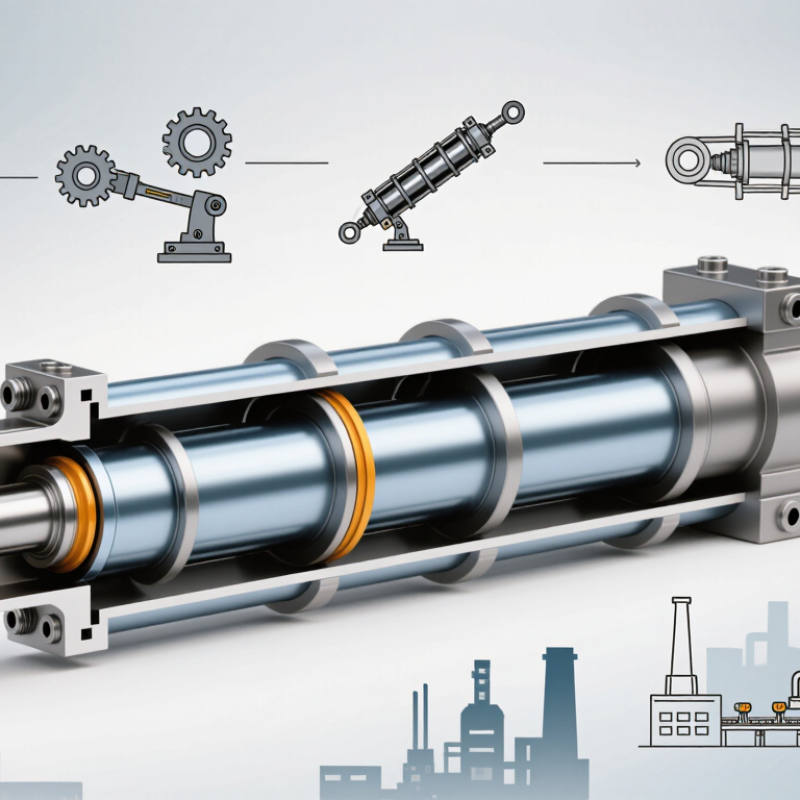
A multi-stage cylinder, often called a telescopic cylinder, uses nested tubes to create a long stroke from a short retracted package. The smallest tube sits inside the next larger section, like segments of a folding measuring stick. Hydraulic pressure moves the stages outward in sequence. The exact sequence depends on the cylinder design and hydraulic circuit.
As each stage extends, the working area changes, so available force and speed can change too. That matters. A cylinder lifting a load may move differently near the end of its stroke than at the beginning.
Some models retract through gravity or an external load; others use hydraulic pressure for powered retraction. Check the cylinder’s rated pressure, stroke, mounting, and load direction before selecting one. Compact does not mean simple. Side loading, poor alignment, oil temperature, and wear can affect smooth movement and service life. Real motion can be less smooth. Maintenance notes and operating conditions are useful evidence, though they are sometimes overlooked.
Multi-stage cylinders extend a long distance from a compact closed length. Telescopic models use nested sleeves, making them useful where installation space is limited. Single-acting designs often extend under hydraulic pressure and retract through gravity or an external load. Double-acting versions use pressure for both extension and retraction, allowing more controlled movement. Common applications include dump trucks, agricultural machinery, refuse vehicles, and lifting platforms. These are not interchangeable.
Grand View Research’s 2024 Hydraulic Cylinder Market report estimated the overall global market at about US$15.7 billion in 2023. That figure covers hydraulic cylinders broadly, not multi-stage units alone. When comparing Chinese manufacturers, check stage count, rated pressure, stroke, closed length, and load direction against your actual duty cycle. Ask for dimensional drawings and test records, not just a maximum-pressure figure. A pressure rating alone cannot show how a cylinder behaves near full extension. One point is easy to miss. Side loading can accelerate seal wear, especially when a vehicle operates on uneven ground. Cycle testing under representative loads offers useful evidence, though real service conditions are rarely perfectly repeatable. (Grand View Research, Hydraulic Cylinder Market Size, Share & Trends Analysis Report, 2024)
China Best Multi Stage Cylinder Manufacturers?
China’s Multi-Stage Cylinder Manufacturing Landscape
China’s multi-stage cylinder sector combines metalworking, hydraulic design, and supplier networks serving construction, transport, and industrial equipment. Production is concentrated in established manufacturing regions, where machining, tube processing, welding, and assembly can often be coordinated nearby. This can shorten communication loops, but proximity alone does not guarantee consistent quality.
A well-made cylinder depends on details that are easy to miss in a catalog. Ask how suppliers control concentricity, surface finish, weld quality, and seal-groove dimensions. Request test records for leakage, operating pressure, stroke, and load. Details matter. A clear drawing review and sample inspection can reveal whether a manufacturer understands the application or is simply matching a listed specification.
Capacity, materials, and inspection methods vary across factories, even within the same region. Some facilities have advanced measuring equipment, while others rely more heavily on manual checks. That difference deserves attention. Discuss duty cycle, side loads, temperature, and maintenance access before comparing prices. A technically sound supplier should explain its process and acknowledge design limits. Still, paperwork and factory audits cannot replace testing a cylinder under realistic working conditions. An occasional gap between stated capability and production reality is worth investigating, not ignoring.
This overview compares common product and manufacturing capabilities, rather than ranking individual suppliers. Figures and configurations below are typical engineering references; actual limits depend on the cylinder design, materials, operating conditions, and required service life.
| Comparison Dimension | Common Configurations or Practices | Typical Technical Considerations | Common Applications | What Buyers Should Verify |
|---|---|---|---|---|
| Multi-stage cylinder design | Telescopic construction with nested sleeves; designs may be single-acting or double-acting. Two to five stages are common in many applications, with custom stage counts determined by the required retracted length and extension. | More stages can provide a long extended stroke from a compact retracted length, but add sealing interfaces and design considerations for stability and service life. | Dump bodies, trailers, lifting equipment, agricultural machinery, and mobile platforms. | Confirm stage count, closed length, total stroke, mounting geometry, extension sequence, and return method. |
| Pressure and load design | Designed to match the hydraulic system and duty cycle. Mobile hydraulic systems commonly operate in the 16–25 MPa range, but cylinder ratings are application-specific. | Rated pressure, peak pressure, side loading, buckling risk, and load direction must be considered together. A system pressure range is not a substitute for a cylinder rating. | Vehicle-mounted equipment, material handling, construction machinery, and industrial lifting systems. | Request the rated and test pressures, load calculations, allowable side load, and applicable safety factors. |
| Materials and surface treatment | Steel is widely used for cylinder barrels, rods, and stages; material grade and protective treatment are selected for the operating environment. | Rod finish, corrosion protection, straightness, and surface hardness affect wear and sealing performance. Requirements depend on contamination, moisture, and exposure. | Indoor industrial equipment as well as outdoor and mobile machinery. | Specify material certificates, rod surface requirements, corrosion-protection method, and any environmental qualification. |
| Machining and assembly | Typical processes include tube and stage machining, honing or precision finishing where required, welding, seal installation, and controlled assembly. | Dimensional accuracy, concentricity, weld quality, cleanliness, and seal compatibility are important to smooth movement and leakage control. | Custom cylinders and production runs for machinery manufacturers and equipment service providers. | Review process controls, inspection records, weld procedures where applicable, and traceability for critical components. |
| Testing and quality assurance | Common checks include dimensional inspection, functional cycling, leakage checks, and pressure testing according to agreed product requirements. | Test procedures and acceptance criteria should reflect the specified design and operating conditions; test pressure and duration should be documented. | All applications, with additional validation for high-cycle or safety-critical equipment. | Ask for a written inspection and test plan, test reports, acceptance limits, and details of any endurance testing. |
| Standards and documentation | Applicable standards depend on cylinder type and design. ISO 6020 and ISO 6022 address dimensions and mounting interfaces for specified hydraulic cylinder series; they do not cover every telescopic-cylinder design. | Standards should be matched to the product scope and agreed contractually. Drawings and technical documents should define interfaces and operating limits. | Projects requiring interchangeability, documented engineering controls, or formal procurement specifications. | Confirm the exact standard and edition, dimensional tolerances, drawings, material documentation, and quality-system records required. |
| Customization and service support | Common project variables include stroke, stage sequence, port location, mounting style, seals, coatings, and hydraulic connections. | Design changes can affect stability, extension behavior, maintenance, and compatibility with the machine’s hydraulic circuit. | Original equipment manufacture, replacement cylinders, and application-specific machinery. | Provide operating loads, duty cycle, mounting drawings, fluid type, temperature range, and expected maintenance conditions before approval. |
When evaluating Chinese multi-stage cylinder manufacturers, begin with the application, not the catalog. Share the required stroke, load, mounting space, operating pressure, and duty cycle. Ask whether the proposed design accounts for side loading and uneven movement. Small details matter. A cylinder that fits a drawing may still bind under real conditions.
Request material specifications, seal information, inspection records, and a clear test procedure. Ask how each stage is checked for leakage and smooth extension, and whether sample units can be tested under your actual load. Evidence beats broad claims. A polished factory tour is useful, but it cannot replace traceable quality records or consistent sample results. Check how the supplier handles drawing revisions, production changes, and reported failures. Response time matters. So does clarity. Compare quotations line by line, including packaging, lead time, and spare-part support. I would not treat the lowest price as a warning by itself; sometimes the specification is simply leaner. That needs a closer look. And a small weakness remains: even a well-documented sample cannot guarantee every production batch will behave identically.
Suggested evaluation weights, not results from a market survey. Compare manufacturers using documented evidence such as test reports, material traceability, dimensional inspection records, customization capability, delivery performance, and after-sales support.
Choosing a multi-stage cylinder manufacturer starts with the duty cycle, not the catalog. Record the required stroke, retracted length, load, mounting orientation, operating pressure, and side load. A telescopic cylinder can fit a tight space, but each stage adds seals and potential leakage points. Small details matter. Ask for force and stability calculations at full extension, plus drawings showing ports, cushions, and mounting dimensions. A polished quotation is not proof that the design suits your machine.
For pneumatic applications, energy use deserves attention. The U.S. Department of Energy’s Improving Compressed Air System Performance sourcebook reports that compressed air can account for about 10% of electricity used in U.S. manufacturing. That figure is not specific to cylinders, but it makes leakage and air consumption worth checking. Request test conditions, cycle-life data, seal options, and maintenance guidance. For hydraulic applications, verify pressure ratings, fluid compatibility, and heat limits instead. The International Federation of Robotics’ World Robotics 2024 report counted 4,281,585 industrial robots in operation worldwide in 2023, underscoring how tightly actuators must integrate with automated equipment. One uncomfortable gap: supplier data may not match your actual cycle. Confirm performance with a representative load and duty cycle before specifying production quantities.
5107 County Road C
Manitowoc, WI 54220
920-726-4526