920-726-4526



China’s FRP industry serves construction, infrastructure, electrical, and industrial projects with lightweight composite profiles. A Frp Rectangular Tube can offer corrosion resistance, electrical insulation, and a useful strength-to-weight ratio. Yet performance depends on more than the material name. Resin type, fiber content, wall thickness, pultrusion quality, and dimensional tolerances all matter.
This guide to China’s top 10 FRP rectangular tube manufacturers is intended to help buyers compare suppliers, not to promise a fixed ranking. Company capabilities and product ranges can change, so confirm current information directly. Ask for technical data sheets, sample dimensions, test reports, and details about quality control. Look closely at corner consistency, surface finish, and whether tube dimensions match your drawings. Small differences matter.
A strong supplier should explain its production process and discuss practical limits. It should also respond clearly when a custom profile needs adjustment. That conversation can reveal more than a polished catalog. No list is perfect. Supplier claims still need checking. Consider lead times, packaging, export experience, and after-sales support alongside price. The lowest quotation may not reflect the full cost of a project. Use this overview as a starting point, then verify specifications and samples before making a purchasing decision.
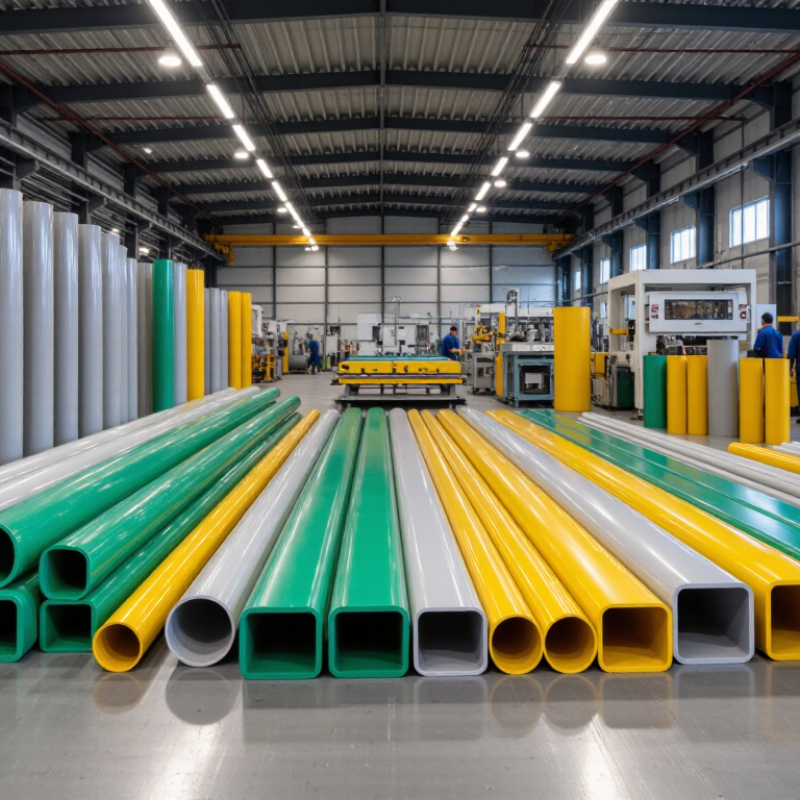
FRP rectangular tubes are made by pultrusion: continuous fibers pass through a resin bath, then a heated die forms and cures the profile. The process creates a consistent cross-section, useful for frames, supports, and cable trays. It also means wall thickness and fiber alignment matter; a tube can be stiff along its length but less resistant to loads across its walls.
Glass fiber is common because it balances strength and cost; carbon fiber can increase stiffness but usually raises material cost. Polyester, vinyl ester, and epoxy resins offer different balances of price, chemical resistance, and temperature performance. The Federal Highway Administration’s technical review of FRP materials reports typical densities around 1.5–2.0 g/cm³, compared with steel at about 7.85 g/cm³. Lighter handling is a clear benefit. It does not guarantee better performance in every application.
Tips: Check the manufacturer’s test data for load direction, wall thickness, and resin type. For outdoor use, ask about UV protection and water absorption. Inspect cut ends, too; they can expose fibers. Small detail, big consequence. Resin selection is often treated as a footnote, but it deserves a second look when chemicals or heat are present.
Supplier evaluation guide: This table presents ten technical and manufacturing criteria to compare suppliers. It does not rank or identify individual companies.
| No. | Evaluation area | Technical facts and common options | What buyers should verify |
|---|---|---|---|
| 1 | Pultrusion process | Pultrusion is a continuous process in which reinforcement is impregnated with resin and pulled through a heated shaping die. It is commonly used for FRP profiles with a consistent cross-section. | Ask about the production method, available profile shapes, die capability, and how the supplier controls cure and dimensional consistency. |
| 2 | Fiber reinforcement | E-glass is widely used in structural pultruded profiles. Carbon or other specialty fibers may be selected for particular stiffness, weight, or performance requirements. | Confirm fiber type, reinforcement layout, and whether the stated properties apply to the actual rectangular tube construction. |
| 3 | Fiber orientation | Pultruded profiles generally have most continuous reinforcement aligned with the pulling direction. FRP properties are therefore directional rather than identical in every direction. | Review longitudinal and transverse properties separately, especially for loads across the tube, at connections, or around cut-outs. |
| 4 | Polyester resin | Unsaturated polyester resin is a common, economical matrix option for pultruded FRP. Suitability depends on the service environment and the specific formulation. | Check the resin grade and documented chemical, temperature, and weathering suitability for the intended application. |
| 5 | Vinyl ester resin | Vinyl ester resins are commonly considered where improved chemical resistance or toughness is needed compared with standard polyester formulations. | Request compatibility information for the actual chemicals, concentrations, temperatures, and exposure conditions involved. |
| 6 | Epoxy resin | Epoxy systems can offer useful adhesion and mechanical performance, but pultrusion suitability and final properties depend on the resin system and process. | Confirm that the offered epoxy profile is designed for the specified process and that test data match the required service conditions. |
| 7 | Profile dimensions | Rectangular tubes are defined by their outside width and height, wall thickness, corner geometry, and length. Available sizes and tolerances vary by product and tooling. | Obtain a dimensioned drawing and agreed tolerances for outside dimensions, wall thickness, straightness, squareness, and cut length. |
| 8 | Mechanical properties | Strength and stiffness depend on the fibers, resin, reinforcement arrangement, geometry, and test direction. A generic material value may not represent a finished tube. | Request test methods and product-specific data, including the direction and specimen configuration used for each reported value. |
| 9 | Weathering and exposure | Outdoor performance depends on the resin formulation, surface finish, UV protection, temperature, moisture, and other exposure conditions. No single finish suits every environment. | Specify indoor or outdoor use, UV exposure, moisture, chemicals, and operating temperature; ask what protective finish or maintenance is recommended. |
| 10 | Quality documentation | Inspection plans and product documentation can support repeatable supply. Relevant evidence may include dimensional inspection records, material details, and test reports. | Agree on acceptance criteria, batch traceability, inspection frequency, packaging, and the documents supplied with each order. |