
An Automobile Bushing may look like a small component, but its performance can affect vibration, noise, handling, and service life. In 2026, choosing a supplier means looking beyond a low unit price or a polished catalogue. Small parts. Large consequences.
Start with the application. A bushing used near a hot engine faces different demands from one exposed to road salt, steering loads, or repeated suspension movement. Share clear drawings and operating conditions, including expected loads, temperature range, motion, and contact with oils or other fluids. A supplier should explain material choices and tolerances in practical terms, not simply promise a perfect fit.
Evidence matters. Ask for relevant test reports, dimensional inspection records, material specifications, and details on production controls. Where possible, compare samples under conditions that reflect actual use. A factory visit or structured supplier audit can reveal how parts are molded, bonded, inspected, and traced. Still, one successful sample does not prove every production batch will match. That point is easy to overlook.
Evaluate communication, delivery consistency, defect handling, and capacity alongside technical capability. Digital tracking and faster product-development tools may help, but only when they produce useful records and dependable decisions. Request clear answers about lead times, corrective actions, and change control. Then compare total cost, including testing, installation, downtime, and warranty exposure. The cheapest offer may not stay cheap. Yet the most expensive supplier is not automatically the safest choice. A careful selection process balances verified quality with realistic commercial needs—and leaves room to question assumptions before they become costly problems.
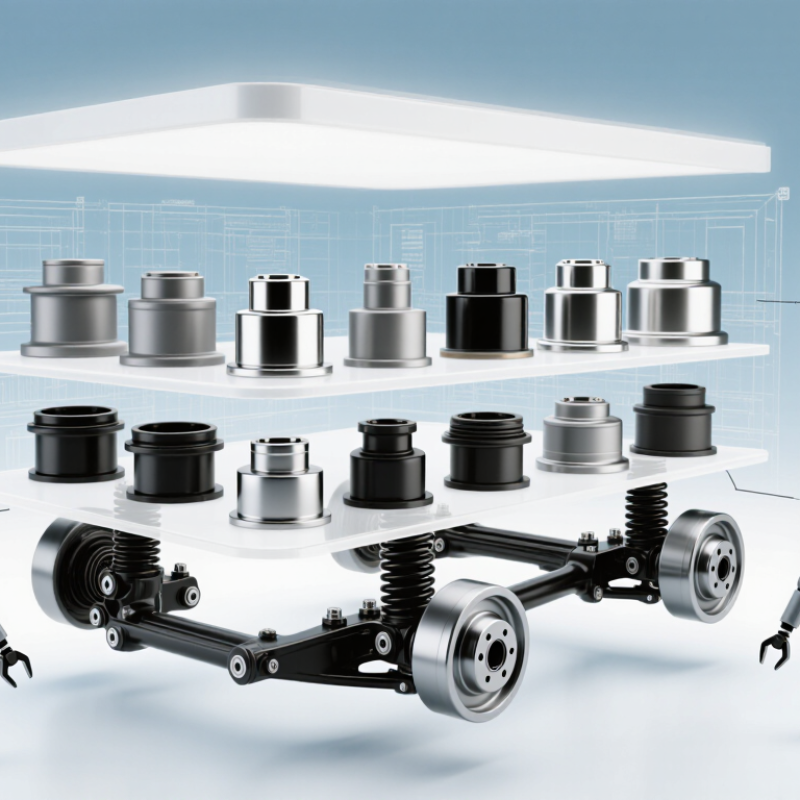
How to Choose an Automobile Bushing Supplier in 2026
Define the vehicle before requesting quotes. Record its platform, model year, axle position, and suspension layout. A front control-arm bushing does not face the same motion or loads as a rear subframe mount. Identify the required design, too: bonded rubber, hydraulic, or another construction. Then share drawings, dimensions, target stiffness, and expected service life. Small details matter.
Operating conditions narrow the choice. Specify temperature range, road salt, oil exposure, vibration, peak loads, and duty cycle. An electric vehicle may need different validation: the IEA’s Global EV Outlook 2024 reports nearly 14 million electric car sales in 2023, about 18% of global car sales. Added vehicle mass and instant torque can change bushing loads, but the actual design still dictates requirements. Ask suppliers for fatigue, aging, and stiffness-versus-frequency test results. Request sample parts and traceable test records. Don’t rely on a catalogue match alone.
Production scale also matters. OICA recorded 93.5 million motor vehicles produced worldwide in 2023, reflecting a wide range of platforms and specifications. Check whether a supplier can maintain material consistency across pilot and volume production. Ask how batches are inspected, and how deviations are reported. A neat spreadsheet may still miss a real-world detail. A short test on the actual suspension can expose it.
When choosing an automobile bushing supplier in 2026, examine the material data, not just the quoted hardness. Ask for test results on compression set, heat aging, fluid exposure, and dynamic stiffness. These properties affect how a bushing handles repeated loads, temperature swings, and road vibration. The U.S. Department of Energy’s Vehicle Technologies Office notes that a 10% reduction in vehicle weight can improve fuel economy by 6–8%. That is a vehicle-level estimate, not a promise that a lighter bushing delivers those gains. Still, material choices should balance mass with durability and noise control.
Design expertise shows in the questions a supplier asks. Do they review load direction, suspension geometry, tolerance stack-up, and the space available for movement? Request drawings, simulation assumptions, and physical validation results for the intended application. The EPA’s 2024 Automotive Trends Report puts average new-vehicle weight at roughly 4,300 pounds, but individual axle loads and operating conditions vary. A catalogue part may fit the dimensions and still behave poorly under real use. Small details matter.
Manufacturing evidence should connect directly to the proposed design. Ask how the supplier controls compound mixing, molding temperature, cure time, and dimensional variation. Look for batch records, inspection plans, and test samples from production—not only a polished sample made for approval. A neat datasheet can still hide a weak validation plan. I would treat that gap as a reason to ask more questions, not as a minor paperwork issue.
A dependable automobile bushing supplier should be able to explain how its quality system works on the factory floor, not just send a certificate. Ask for current audit records, inspection procedures, and examples of corrective actions. Check whether staff can trace a sample bushing from incoming rubber and metal to final inspection. Small details matter. A label on a sample that does not match its inspection record deserves a clear explanation.
Testing should reflect the part’s actual job. Ask how the supplier evaluates stiffness, compression set, bond strength, fatigue, and performance across expected temperatures. Request test reports with dates, sample sizes, acceptance limits, and equipment calibration details. Not just a certificate. Where possible, compare a report with your own drawing and operating conditions; a generic test may miss the load or temperature range that matters.
Regulatory requirements vary by market and application, so confirm which material declarations and product records apply to your intended use. Ask how changes to compounds, tooling, or production sites are reviewed and communicated. No audit is perfect. A tidy document set can hide a weak process, and a capable supplier may have gaps in its paperwork. Keep asking for evidence, then record what remains unresolved before approving production.
| Evaluation dimension | Evidence to request | What to verify | Decision guidance |
|---|---|---|---|
| Quality management system | Current automotive quality-system certificate, certificate scope, issuing certification body, and recent audit findings or corrective-action records. | Confirm that the certificate is valid and covers the actual manufacturing site and relevant processes. IATF 16949 is an automotive quality-management-system standard; certification does not by itself prove that a specific bushing meets its drawing or performance requirements. | Treat an expired, out-of-scope, or unverifiable certificate as a qualification risk. Check current certificate status directly with the relevant certification or oversight source. |
| Product and process approval | APQP timing plan, process flow, process FMEA, control plan, measurement results, material records, and PPAP submission level agreed with the customer. | Check that documents describe the quoted part, production site, tooling, material, and process route. PPAP requirements and submission levels should be agreed with the customer; they are not a universal substitute for customer-specific approval. | Require documented approval before production shipments when the customer’s requirements call for it. Confirm change-control rules for any later process or material change. |
| Rubber and material traceability | Material specifications, batch certificates or test records, incoming inspection results, supplier-change controls, and lot-traceability examples. | Verify the specified elastomer, metal grade, coatings, bonding system, and any customer-approved alternatives. Confirm that production lots can be traced to material batches and manufacturing records. | Do not accept an unapproved material substitution based only on a generic claim of equivalent performance. |
| Dimensional and visual inspection | Inspection plan, drawing balloon report, calibrated equipment list, gauge records, capability studies where required, and samples from the intended production process. | Check critical dimensions, tolerances, datum strategy, bonded interfaces, surface condition, and acceptance criteria against the latest approved drawing and specifications. | Agree measurement methods and sample sizes before comparing results. A prototype measurement report alone may not represent production capability. |
| Mechanical and durability testing | Test plans and reports for the application’s specified load, stiffness, displacement, fatigue, temperature, and environmental conditions. | Confirm test fixtures, conditioning, sample preparation, cycle profiles, failure definitions, and acceptance limits match the customer specification. Rubber tensile and hardness methods can reference applicable ISO methods, such as ISO 37 and ISO 48-4, when appropriate to the material and requirement. | There is no single universal pass threshold for all automotive bushings; use the vehicle or component specification and document any approved deviation. |
| Laboratory competence and calibration | Laboratory scope, equipment calibration certificates, method validation records, and external laboratory accreditation details where applicable. | For outsourced testing, check whether the relevant test is within the laboratory’s ISO/IEC 17025 accreditation scope. Verify calibration traceability and that test methods are suitable for the required measurements. | Accreditation applies to a defined laboratory scope; it should not be assumed to cover every test the laboratory offers. |
| Regulatory and substance compliance | Material declarations, substance-compliance statements, supporting supplier declarations, and applicable market or customer-specific compliance records. | Identify the destination markets and applicable requirements. EU REACH and the End-of-Life Vehicles (ELV) Directive may be relevant to automotive materials and articles; applicability depends on the part, market, and supply-chain obligations. IMDS is an automotive material-data reporting system, not a regulation. | Request current, part-specific declarations and clarify responsibility for updates when materials or regulatory requirements change. |
| Process control and change management | Control-plan records, process monitoring data, maintenance schedules, nonconformance reports, corrective actions, and formal change-notification procedures. | Review controls for molding or curing, bonding, machining, assembly, and final inspection as applicable. Check how the supplier identifies out-of-control conditions and prevents affected product from shipping. | Require prior review or approval for changes to site, tooling, material, process, or sub-supplier when required by the customer’s terms. |
| Capacity and delivery continuity | Documented capacity assumptions, production schedule, lead-time definition, maintenance and contingency plans, and evidence of supply-chain risk review. | Compare demonstrated capacity with forecast demand and identify single points of failure, including critical materials, equipment, tooling, and logistics routes. | Base the decision on documented recovery arrangements and realistic capacity data, not an unsupported assurance of uninterrupted supply. |
| Commercial and technical readiness | Itemized quotation, tooling ownership and maintenance terms, packaging specification, warranty terms, engineering support contacts, and agreed performance indicators. | Check that quoted assumptions match the drawing, forecast, packaging, Incoterms, validation plan, and expected service life. Confirm how warranty claims and root-cause investigations will be handled. | Compare total lifecycle and qualification risk, not unit price alone. Record unresolved technical or commercial items before nomination. |
Evaluation note: Use current customer drawings, specifications, applicable laws, and market-specific requirements as the acceptance basis. Standards and regulatory obligations should be confirmed for the intended part and destination market.
Choosing an automobile bushing supplier in 2026 means checking more than a catalog and a quoted price. Start with production capacity: ask about monthly output, available shifts, equipment, and current utilization. A large stated capacity may not help if the relevant molding line is already full. Request recent delivery records for comparable parts, plus details about material control and inspection. Details matter.
Delivery promises should include each stage, from approved samples to packed goods. Ask how the supplier tracks delays caused by tooling repairs, material changes, or inspection failures. Check performance across busy periods, not just one successful shipment. For cost comparisons, review tooling, testing, packaging, freight, and expected scrap alongside the unit price. A cheaper quote can become expensive when parts arrive late or need rework. Confirm what assumptions the quote depends on.
Support becomes especially important when a bushing behaves differently in the actual assembly. Ask whether technical staff can review dimensions, hardness readings, and test results, and how quickly they respond to a quality concern. Request traceable batch records and a clear corrective-action process. Test samples under relevant temperature and vibration conditions before committing to volume. No checklist predicts every surprise. Leave room for judgment, and pay attention to how directly the supplier answers difficult questions.
When an automobile bushing supplier makes your shortlist, treat its sample as evidence, not a promise. Ask for parts made with the proposed compound, tooling, and production process. Check dimensions with calibrated gauges, then inspect bonding, surface finish, and sleeve alignment. Fit samples to the intended joint and record installation force, movement, and unusual noise. Small details matter. One clean sample cannot prove stable output.
Compare hardness, compression set, and aging results against your drawing and service conditions. If results lack test methods or specimen details, request the underlying records. Keep the questions specific. An audit should follow the part through the plant: incoming rubber, mixing, molding, curing, inspection, and packing. Review process controls, calibration dates, defect logs, and how operators separate rejected parts. Look for real production records, not a presentation built for visitors.
Ask the supplier to explain a recent nonconformance and show how corrective action changed the process. That answer can reveal more than a polished tour. Audits have limits, too. A visit may miss a shift change or seasonal variation. Request a second sample lot later, then compare its measurements before approving production.
Use sample validation and supplier audits to assess the capabilities that matter before making a sourcing decision.
How to read this chart: These illustrative checklist scores (0–100) show how a shortlisted supplier might be assessed. They are not measured market data or industry benchmarks. Verify material traceability, dimensional capability, durability test results, process controls, corrective-action records, and delivery performance using samples and audit evidence.
5107 County Road C
Manitowoc, WI 54220
920-726-4526
