
Choosing the right Tapered Bearing in 2026 is not a catalog exercise. It is a decision about load, speed, temperature, alignment, and service life. A bearing may fit the shaft perfectly and still fail early. Why? Lubrication, contamination, or incorrect preload can change everything. Start with the application, not the part number.
An experienced engineer checks radial and axial loads separately. Then, they examine shock loads, rotation direction, operating temperature, and available space. Single-row designs suit many general applications, while matched pairs can manage combined loads and axial positioning. Contact angle matters. So does the cup-and-cone arrangement. Manufacturer load ratings, ISO-based dimensions, clearance data, and installation instructions should guide the final choice. Do not trust a promising online listing alone.
Real equipment adds complications. A dusty conveyor, a hot gearbox, and a slow trailer hub need different decisions. In maintenance reviews, early damage often points to poor sealing, over-tightening, or uneven mounting—not weak steel. Still, calculations are not perfect. Actual duty cycles can be difficult to predict. Recheck assumptions against inspection records and field measurements. When evidence conflicts, pause and investigate before ordering. The best choice balances performance, availability, total cost, and the technician’s ability to install and monitor it correctly.
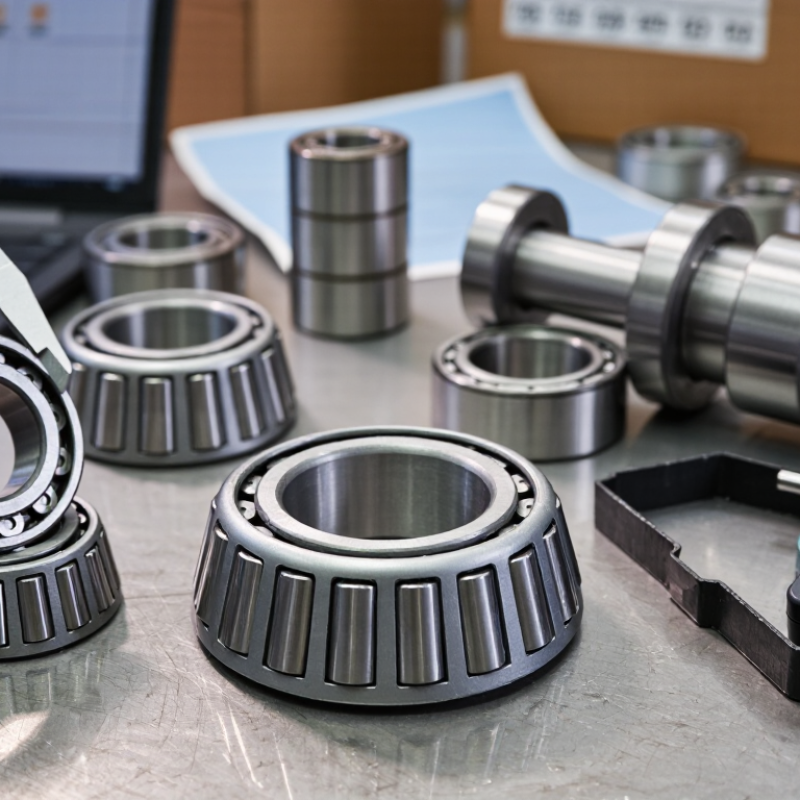
A tapered bearing uses a cone-shaped inner ring, matching outer raceway, and tapered rollers. This geometry carries radial loads and axial loads in one assembly. The rollers meet at a common apex, reducing sliding during rotation. Proper alignment remains essential.
In practical maintenance, I inspect the bearing seat, shaft shoulder, and lubricant path before selecting a size. A catalog load rating is useful, but it is not the whole answer. Speed, shock loading, temperature, contamination, and expected life change the selection. A truck hub may need strong sealing. A precision gearbox may need lower friction and carefully controlled preload. Small details matter.
Too little clearance can create heat, noise, and early fatigue. Too much clearance can allow shaft movement and uneven contact. I use measured endplay, torque checks, and manufacturer tolerances rather than guesswork. That process is not perfect. Housing distortion, installation force, or an overlooked spacer can alter the result. In 2026, digital monitoring can reveal temperature and vibration trends, yet sensors cannot correct poor fitting. Choose the bearing from real operating data, then verify it after installation under normal load.
Start with the load, not the catalogue number. Tapered bearings handle combined radial and axial forces, but their internal geometry must match the duty. A wheel hub may face shock loads, while a conveyor reducer sees steady torque. Measure both forces and their directions. ISO 281:2007 provides the basic rating-life method, using dynamic load rating, equivalent load, and operating speed. Yet calculated life is not a promise. Misalignment, contamination, and poor lubrication can shorten it sharply.
Speed changes the decision. High rotational speed increases heat, lubricant shear, and cage stress. Check the limiting speed, but also calculate temperature under real load. The U.S. Department of Energy reports that motor-driven systems consume about 69% of electricity in U.S. manufacturing. Even small friction losses can become expensive across continuous production lines. Operating conditions matter just as much. Dust calls for stronger sealing, while washdown areas demand corrosion-resistant materials and careful relubrication. Excessive preload may reduce vibration, but it can also create damaging heat.
Tips: Record load cycles, peak shocks, shaft speed, ambient temperature, and lubricant type. Inspect used bearings for pitting, smearing, or discoloration. These marks often reveal the real failure cause. Do not trust a single spreadsheet result. Field measurements may disagree. That is useful. Recheck the assumptions before final selection. A bearing that survives in a clean test room may fail beside a hot, dusty gearbox. Performance data should be verified against ISO 281, manufacturer-neutral test procedures, and actual maintenance records.
Choosing the right tapered bearing in 2026 starts with matching dimensions to the real load path. Measure the shaft and housing, not only the old bearing. Check bore diameter, outside diameter, width, and contact angle. Small errors matter. A loose fit can allow creep, while an excessive interference fit may reduce internal clearance.
Material selection should reflect temperature, speed, contamination, and shock loading. Through-hardened bearing steel suits many industrial applications when lubrication and sealing are controlled. Stainless steel can resist corrosive environments, but it may offer different load and hardness characteristics. For unusual temperatures or heavy impact, request documented material data and heat-treatment records. Do not rely on appearance.
Internal clearance needs equal attention. Too little clearance can create heat, noise, and premature fatigue. Too much can increase vibration and uneven roller contact. Operating clearance changes after mounting because fits and temperature alter the ring dimensions. Use the manufacturer’s clearance tables, relevant ISO guidance, and measured shaft tolerances before final selection. In field work, I have seen a correctly sized bearing fail because thermal growth was ignored. That mistake is easy to repeat. Recheck the calculation. Consider lubricant viscosity, preload, mounting force, and housing distortion together. A practical choice also allows inspection access and future adjustment. The best specification is not the most complicated one; it is the one supported by traceable measurements, clear records, and service conditions that match reality.
How to Choose the Right Tapered Bearing in 2026?
Comparing Sealing, Lubrication, and Installation Requirements
A tapered bearing should match the machine’s load, speed, temperature, and contamination level. Sealing often decides service life before load capacity does. In dusty workshops, choose protection that limits abrasive particles near the rollers. In hot assemblies, check whether the seal material tolerates continuous heat. A tight seal helps, but it may increase friction and operating temperature.
Lubrication needs equal attention. Use the grease or oil specified for the bearing clearance and working temperature. Too much grease can create heat during high-speed rotation. Too little lubricant can leave polished raceways and visible scoring. I have seen technicians add grease repeatedly, assuming more protection was better. Their first choice was wrong. A measured quantity and clean application usually perform better.
Installation also affects real-world reliability. Confirm shaft and housing dimensions with calibrated tools, not visual judgment. Press only against the ring receiving the mounting force. Never transfer impact through the rollers. Set the adjustment carefully, because excessive preload raises temperature and reduces life. Insufficient preload may create vibration and uneven wear. Check rotation by hand before startup. It should feel smooth, not tight or gritty. Keep the work area clean. A single metal chip can damage a new bearing. Recheck assumptions when operating conditions change.
Comparison of sealing, lubrication, and installation requirements for common tapered-bearing configurations.
Relative requirement index: 1 = low, 5 = high. Sealed bearings generally reduce maintenance and improve contamination protection, while open bearings provide greater flexibility for relubrication and inspection. Correct adjustment, preload, and alignment remain essential for every configuration.
A tapered bearing should match real loads, not only catalog ratings. Measure radial load, axial load, speed, temperature, and shaft alignment. A delivery conveyor may face steady loads, while a crusher experiences shock and vibration. These conditions require different safety margins. Check dynamic and static load ratings against calculated duty cycles. Use recognized engineering standards and verified manufacturer data. Guesswork becomes expensive quickly.
Performance validation should continue after installation. Record operating temperature, vibration, noise, and lubricant condition during the first weeks. A 10°C rise may indicate excess preload, poor lubrication, or misalignment. Inspect raceways during scheduled maintenance. Uneven polishing can reveal load concentration before failure occurs. Keep accurate records. They support reliable decisions and reveal changing conditions.
Maintenance and cost must be judged together. A cheaper bearing may require frequent shutdowns, special tools, or more lubricant. A premium option may not recover its cost in a lightly loaded application. Compare purchase price, installation time, energy loss, inspection labor, and expected service life. Sealing, clearance, and adjustment settings also affect total cost. One calculation can be wrong. Recheck assumptions against field measurements. A clean installation still matters, because a small contaminant can damage a precision surface.
5107 County Road C
Manitowoc, WI 54220
920-726-4526