
Stecker Machine Blog

Why Choose Roll Filter Media for Industrial Filtration?

Industrial filtration is easy to overlook until a production line slows, a fan works harder, or dust settles on nearby equipment. Roll Filter Media offers a practical way to capture airborne particles in ventilation and process-air systems. Its continuous format can be cut to suit different frames, making replacement straightforward in many facilities. But a roll is not a universal fix.

The need for reliable filtration is clear. The World Health Organization’s 2022 air-quality update reported that 99% of the global population lived in areas where air quality exceeded its guideline limits, using data from 2019. This is not an industrial-filter performance measure, but it shows why controlling airborne particles matters. The International Energy Agency’s Energy Efficiency 2023 report also highlights industry’s substantial role in energy use. In practice, filter selection can affect airflow resistance and fan demand, so efficiency should be assessed alongside particle capture.

Details matter. A maintenance team should compare media efficiency, dust-holding capacity, pressure drop, moisture tolerance, and operating conditions—not just price per roll. A clean filter may look unremarkable. Its performance is not. Site trials and pressure-drop records can help confirm whether a chosen grade suits the actual dust load and replacement schedule. One limitation deserves attention: media alone cannot compensate for poor sealing, unsuitable equipment, or delayed maintenance. Even careful estimates can miss changing dust conditions. That is why choosing Roll Filter Media should begin with the application, verified specifications, and real operating data.
Why Choose Roll Filter Media for Industrial Filtration?

What Roll Filter Media Is and How It Is Constructed

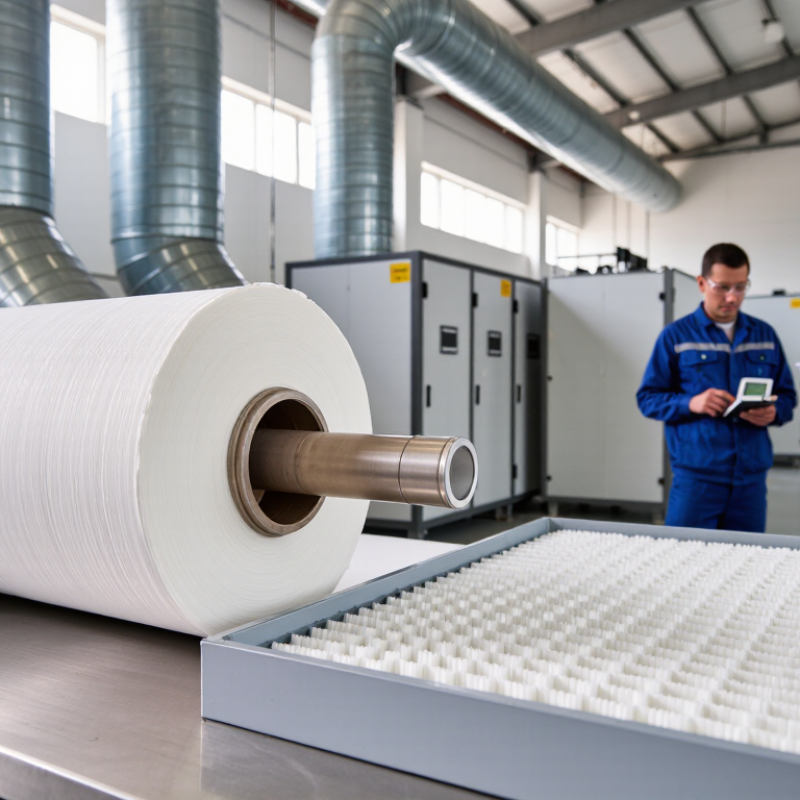
Roll filter media is a continuous sheet of porous material supplied in a wound roll. It is cut to fit frames or processing lines, so width, thickness, and roll length matter in daily use. The sheet is usually made from synthetic fibers, though some applications use blends. Fibers are arranged as a web, then bonded by heat, resin, or mechanical methods such as needle punching. Each method affects stiffness, pore structure, and resistance to handling.

Some media use layered construction, with coarser fibers on the air-entry side and finer fibers deeper in the sheet. This can help distribute dust through the material instead of loading only its surface. Not every roll has a clear gradient. That sounds simple, but it isn’t always. Fiber diameter, bonding, and production consistency all influence airflow and particle capture. A close look may reveal very little.

In practice, compare media using operating conditions, not appearance alone. Check airflow, pressure drop, dust-holding capacity, and the target particle range. A technician can also inspect whether the roll feeds evenly and stays seated in its frame. Look closely. A loose edge or uneven thickness may cause bypass or uneven loading. Construction involves trade-offs: tighter media may capture more particles, yet increase resistance to airflow. Reviewing test data for the intended conditions is more reliable than relying on a single specification.

Why Choose Roll Filter Media for Industrial Filtration?

What Roll Filter Media Is and How It Is Constructed

Roll filter media is supplied in continuous lengths and can be cut or formed for industrial filter applications. Its fiber blend, density, and layered construction influence filtration performance and airflow resistance. The chart shows selected ISO 16890 ePM1 class thresholds; it is a classification reference, not a performance claim for every roll media product. Check the tested rating and operating requirements when selecting media.

How Roll Filter Media Captures Airborne Particles

Why Choose Roll Filter Media for Industrial Filtration?

How Roll Filter Media Captures Airborne Particles

Roll filter media captures airborne particles through several mechanisms. Larger particles may strike fibers directly as air changes direction, while smaller ones can diffuse through the fiber network and collide with its surfaces. Some particles become trapped between fibers. Small particles matter.

The U.S. Environmental Protection Agency defines PM2.5 as particles 2.5 micrometers or smaller, a size range that can pass through less efficient filters. ASHRAE Standard 52.2-2017 sets MERV 13 minimum efficiency thresholds of 50% for 0.3–1 micrometer particles, 85% for 1–3 micrometers, and 90% for 3–10 micrometers. These are test-based ratings, not a guarantee for every roll media product or operating condition.

In practice, a layered or progressively denser fiber structure can collect particles while allowing air to pass through. But airflow matters, too. As dust accumulates, pressure drop can rise, so operators should check the filter and system conditions rather than rely on a fixed replacement guess. A tempting shortcut is assuming thicker media always filters better; it does not. Efficiency, airflow, fit, and dust-holding capacity all affect performance. That distinction is easy to overlook in a busy plant.

Materials and Design Features That Shape Filtration Performance

Roll filter media performs through more than its fiber material. Synthetic fibers often tolerate moisture better, while cellulose blends can offer economical dust capture in dry applications. Fiber diameter, web density, and layered structure affect how particles are trapped and how quickly resistance builds. A loose upstream layer can catch larger lint; finer downstream layers target smaller dust. The exact balance depends on airflow and contaminant load. Not always obvious.

Design choices matter at the frame, too. A poorly fitted roll can let air bypass the media, making published efficiency figures irrelevant in practice. ASHRAE Standard 52.2 rates filters by particle-size range; MERV 13 minimum efficiencies are 50% for 0.3–1.0 μm, 85% for 1.0–3.0 μm, and 90% for 3.0–10 μm. The U.S. EPA’s Guide to Air Cleaners in the Home reports the same MERV 13 benchmarks for HVAC filters, though industrial conditions may differ. Check pressure drop and dust-holding capacity alongside efficiency. A tighter web may capture more, but it can also increase fan load. That trade-off is easy to overlook, especially when media is selected from a sample sheet rather than tested in the actual housing.

Why Choose Roll Filter Media for Industrial Filtration? - Materials and Design Features That Shape Filtration Performance
Media Type Typical Material and Design Filtration Characteristics Airflow and Pressure-Drop Considerations Moisture and Operating Considerations Common Industrial Uses
Cellulose Paper-like fibers formed into a porous web; may be supplied as a flat roll or supported with a scrim. Can provide economical particulate capture. Performance depends on fiber structure, media thickness, and any treatment applied. Initial resistance varies by grade and airflow. Dust accumulation increases resistance, so changeout is commonly based on pressure drop or a maintenance limit. Untreated cellulose can lose strength or become damaged when exposed to excessive moisture. Check compatibility with humidity, temperature, and process contaminants. General ventilation, prefiltration, and selected dry-process applications.
Synthetic polyester Nonwoven polyester fibers, often thermally bonded or mechanically entangled; available in different thicknesses and fiber densities. Provides depth loading, with particles captured through the media structure. Some grades are washable or reusable when specifically designed and approved for that purpose. Loft and density influence both dust-holding capacity and resistance. A more open structure may allow higher airflow but may capture fewer fine particles. Often more tolerant of humid conditions than untreated cellulose, but temperature and chemical resistance depend on the fiber grade and binder or finish. Ventilation systems, equipment intake filters, and general industrial air filtration.
Cellulose–polyester blend Combined natural and synthetic fibers, designed to balance cost, handling strength, and filtration behavior. Properties vary with the blend ratio and web construction. The synthetic component can improve strength, while cellulose contributes to the media structure. Airflow resistance and dust capacity are grade-specific; compare published performance data for the intended face velocity and loading conditions. Moisture tolerance is not determined by the blend alone. Confirm the effects of humidity, condensate, and process chemicals with the supplier’s technical data. General-purpose filtration where a balance of performance and material cost is needed.
Fiberglass Fine glass fibers arranged in a web; some roll products use progressively denser layers or a reinforcing backing. Fine fibers can support efficient particle capture in suitable grades. Media structure and fiber diameter affect efficiency and resistance. Higher capture efficiency can be accompanied by greater resistance, depending on the grade and operating conditions. Correct sizing helps avoid excessive face velocity. Use within the manufacturer’s specified temperature range and follow handling guidance to prevent fiber release or damage during installation and service. Selected HVAC and industrial air-filtration stages, including applications requiring fine-particle capture.
Progressive-density media A layered or graded web with a more open upstream face and a denser downstream region; it may be made from synthetic or blended fibers. Uses media depth to distribute particle capture through more of the material rather than concentrating it only at the surface. Can support useful dust-holding capacity, but actual service life and pressure-drop development depend on dust type, concentration, airflow, and media grade. Layer integrity and any binder or backing must suit the operating environment. Inspect for damage, bypass, or uneven loading. Panel-filter cut-to-size applications and prefiltration in industrial ventilation systems.
Tackified roll media Fibrous media treated with an adhesive or tackifying finish to help retain captured particles. The tacky surface can improve retention of collected dust and reduce particle release under suitable conditions; it does not replace a specified efficiency rating. Surface loading and dust buildup can raise resistance. Replace the media according to the equipment’s pressure-drop limits and maintenance procedure. Finish performance can be affected by temperature, moisture, and chemical exposure. Confirm compatibility before use. Paint-booth intake filtration and other applications where retaining airborne overspray or dust is required.

Selection note: Filtration efficiency, airflow resistance, dust-holding capacity, and service life are grade- and application-specific. Compare test data obtained under a relevant standard, and verify compatibility with the actual airflow, particle type, temperature, humidity, and chemical exposure.

Industrial Applications Across Different Environments

Why Choose Roll Filter Media for Industrial Filtration?

Industrial Applications Across Different Environments

A metalworking shop may fill its intake air with fine dust, while a packaging line faces fibers and changing humidity. Roll filter media suits systems that need a continuous filter surface, especially where dust loading varies across shifts. Operators can advance fresh media as it becomes dirty. The practical details matter: airflow, particle size, moisture, and replacement frequency should guide selection, not the roll format alone.

The International Energy Agency’s Energy Efficiency 2023 report estimates that industry used about 37% of global final energy in 2022. That scale makes pressure drop worth monitoring: a loaded filter can increase resistance and affect fan energy. WHO’s 2022 air-quality update reports that 99% of people worldwide breathe air above its guideline limits. This is an ambient-air finding, not a measurement of factory exposure, but it underscores why filtration decisions need site-specific checks.

In a dusty workshop, a coarse roll may protect downstream filters; in a cleaner assembly area, finer media may be appropriate if the fan can handle the added resistance. Conditions change. Humid air can make dust cling, and a roll that advances too slowly may leave clogged sections in service. A simple pressure gauge and a log of roll changes help reveal patterns. Still, readings alone can miss uneven loading across the filter face.

Benefits and Factors to Consider When Choosing Roll Filter Media

Roll filter media can simplify industrial filtration because operators can cut material to match different housings and change it as needed. A continuous roll may reduce interruptions when filters are replaced often. It can also help maintain a steady supply of media on site. Fit matters. A roll that is too narrow may leave gaps, while excess material can fold and restrict airflow.

Choosing the right grade requires more than comparing thickness or price. Consider the dust type, particle size, airflow, operating temperature, and exposure to moisture or oil. Media with tighter filtration may capture smaller particles, but it can also create greater pressure drop. Check the equipment’s recommended limits and monitor pressure during operation. Small details matter.

Also assess fiber type, permeability, roll width, length, and ease of handling. A durable backing can help prevent tearing during installation, though it may not suit every housing. Ask for test data under conditions close to your process, not just general efficiency figures. In practice, selection can involve compromise. A cheaper roll may need more frequent changes, while a high-efficiency option may reduce airflow. There is no perfect grade for every line.