
China’s EV market is expanding, and reliable roadside charging is becoming more important. Buyers researching China’s top 10 emergency EV charger suppliers should look beyond attractive product photos. An Emergency Ev Charger can be a portable unit, a vehicle-mounted system, or temporary charging equipment. These options serve different needs.
A careful comparison starts with practical specifications. Check power output, connector options, battery capacity, charging time, and weather protection. Ask whether the equipment supports the vehicle models in your fleet. Small details matter. Cable length can affect roadside setup, while unit weight can shape how easily one technician handles it. For fleet managers, response time, service coverage, spare-part availability, and warranty terms deserve equal attention.
This guide introduces ten suppliers for closer evaluation, not as a guaranteed ranking. Supplier capabilities and product ranges can change, so confirm current details directly. Request technical datasheets, test records, and clear explanations of applicable certifications. If possible, see a demonstration under realistic operating conditions. A specification sheet cannot show every setup difficulty. Some advertised performance figures may also depend on temperature, vehicle compatibility, or charging state. That deserves scrutiny. The most suitable supplier is the one whose equipment, support, and documented performance match your actual routes and response requirements. No single option fits every operator.
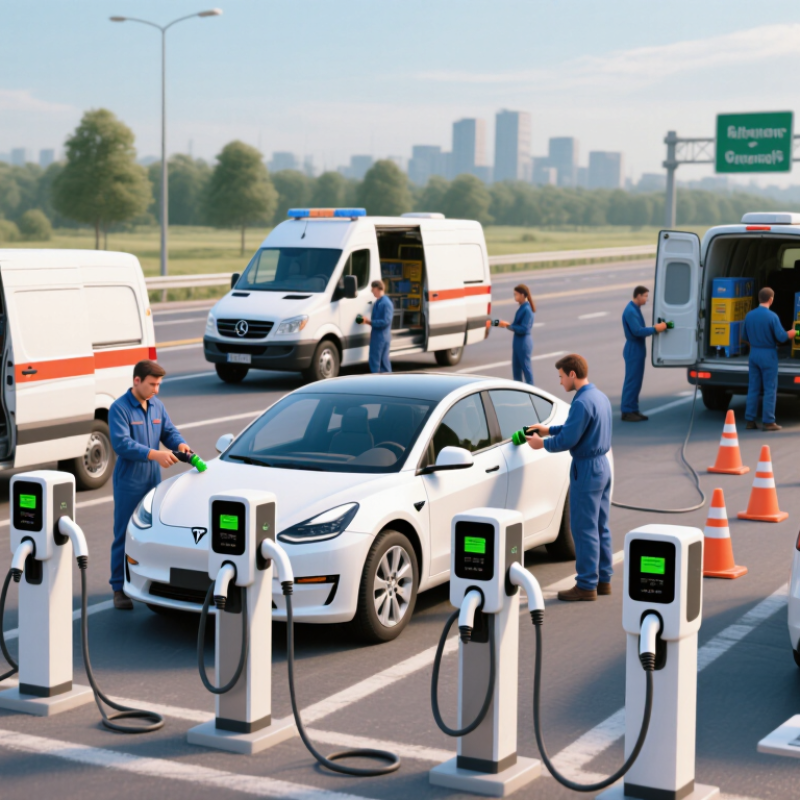
An emergency EV charger provides temporary power when a vehicle cannot reach a regular charging point. It may be a portable unit carried by a roadside service vehicle or a mobile battery system brought to the car. Depending on its design, it supplies alternating current or converts stored energy into direct current. The vehicle and charger communicate before power flows, checking connection and charging limits. A brief session may add enough range to reach a fixed station. Not a full refill.
The IEA’s Global EV Outlook 2024 reports that public charging points grew by about 40% worldwide in 2023. Fast chargers grew faster, at roughly 55%. This wider network helps, but gaps remain on remote roads and during outages. Emergency charging fills a practical gap rather than replacing dependable infrastructure.
Operators should check the vehicle’s connector, battery condition, and safe parking space before connecting equipment. Wet ground, poor visibility, or a damaged cable can complicate a roadside stop. One detail is easy to overlook: a rescue charge may be slow, limited by the unit’s stored energy, or unavailable for some vehicle configurations. That limitation deserves plain disclosure.
China’s emergency EV charger market serves roadside assistance, fleet depots, and temporary charging needs. Suppliers offer portable units, vehicle-mounted systems, and mobile charging equipment. Their capabilities differ. Some focus on power electronics; others integrate batteries, cables, and control software. A supplier list alone cannot show whether a unit suits a particular vehicle or service route. Buyers should verify charging standards, rated output, operating temperature, and installation requirements. Needs proof. Product specifications can also vary between samples and production batches, so written confirmation matters.
Tips: Request test records and clear warranty terms. Ask how quickly common spare parts can be supplied. Check cable length and connector compatibility against the vehicles you actually support. Keep records. A brief live demonstration can reveal awkward setup steps that brochures may miss.
Supplier evaluation should include production capacity, quality controls, and technical support after delivery. Ask for references from comparable deployments, then confirm the details independently. For mobile teams, weight, weather protection, and safe storage deserve attention alongside charging speed. Price is visible; downtime is less so. Market information changes, and online supplier profiles may be incomplete. That is an uncomfortable limitation, but buyers should compare current documents rather than rely on rankings or broad claims.
When evaluating emergency EV charger suppliers in China, define the use case before comparing prices. A roadside unit may need different power, connectors, and weather protection than a charger kept in a fleet vehicle. Ask for rated output, charging protocols, cable length, operating temperature range, and enclosure protection. Details matter. Request test records for the exact model, not a similar-looking product. Check whether the documentation identifies the test method and issuing laboratory. If possible, inspect a sample and try it with the vehicle types you expect to serve. A neat brochure is not proof of dependable field performance.
Supplier evaluation should also cover support after delivery. Ask who diagnoses faults, how replacement parts are supplied, and what response times are realistic in your service area. Clarify warranty exclusions, software update procedures, packaging, and lead times in writing. Ask for references from buyers with comparable applications, while remembering that one successful installation cannot guarantee yours. A factory visit or independent inspection may reveal assembly practices, but neither replaces product testing. Some suppliers may not have every report ready; treat missing evidence as a question to resolve, not an automatic verdict. Compare answers consistently, and document any trade-offs before choosing.
China’s emergency EV charging suppliers serve different roadside needs. The profiles below describe ten common supplier strengths, not a ranking. A portable DC charger maker may offer a wheeled unit for a stranded vehicle. Check its output, connector options, and usable battery capacity. Details matter. A mobile-charging vehicle supplier brings equipment to the driver, while a roadside service operator focuses on dispatch and technician coverage. A modular DC equipment maker can suit depots that need adjustable output. An AC backup supplier may fit slower, overnight recovery.
A fleet-focused integrator designs charging support for taxis, delivery vans, or service vehicles. A power-electronics specialist may provide compact conversion systems and thermal controls. An OEM factory can adapt an existing design for a buyer’s specifications, though customization may affect lead time. A software-enabled provider coordinates requests, locations, and service records. Ask how the system behaves when mobile coverage is weak. A regional service network may offer faster response nearby, but coverage can thin out outside major cities.
The tenth profile is a parts-and-maintenance supplier supporting batteries, cables, and connectors over time. For any supplier, request test records, warranty terms, spare-parts availability, and clear output ratings. Compare real operating limits, not just headline figures. A polished catalog is reassuring; field support is harder to judge. I would verify it with a small trial before relying on it for roadside emergencies.
When comparing emergency EV charger suppliers in China, look beyond the quoted charging power. Check connector compatibility, supported vehicle voltage, output stability, and how quickly the unit can deliver usable energy. A charger rated at high power may perform differently when several vehicles need support. Ask suppliers for test records showing charging performance under realistic conditions, not only laboratory results.
Inspect the enclosure, cable length, display readability, and controls with gloved hands. These details matter at a roadside stop, especially in rain or poor light. Ask how the system handles overheating, low temperatures, and power interruptions. Confirm spare-part availability, warranty terms, and technical support response times. A polished datasheet can still leave practical questions unanswered. No scorecard is perfect.
Tips: Request a live demonstration using a compatible vehicle or test setup. Check the setup time, fault alerts, and recovery process. Ask for references from comparable deployments, but verify the details independently. Record each supplier’s answers in one comparison sheet. Small details matter. A rushed purchase can overlook them.
Suggested evaluation weights for comparing emergency EV charging solutions. Adjust these weights to match your vehicle fleet, operating conditions, and procurement priorities.
The percentages are a sample buyer-defined framework, not market statistics or supplier ratings. Compare documented output power, connector compatibility, usable energy, safety certifications, deployment requirements, and service coverage before choosing a solution.
5107 County Road C
Manitowoc, WI 54220
920-726-4526