


Stecker Machine Blog

China Top 10 Rotary Sensor Manufacturers?

Rotary Sensors convert shaft movement into signals that control systems can measure and use. In factories, they help track motor position, monitor speed, and support accurate motion control. A small difference in resolution or response time can affect a production line’s performance. So can vibration, temperature, dust, or a difficult installation.

This guide introduces ten manufacturers in China serving different rotary sensing needs. The companies may offer optical, magnetic, or inductive designs, with options such as incremental or absolute measurement. Their products can vary in resolution, output type, shaft configuration, environmental protection, and customization. These details matter. A sensor suited to a clean laboratory may not withstand a machine tool’s heat and vibration. Buyers should compare technical datasheets, confirm interface compatibility, and ask about calibration, testing, warranty, and after-sales support. No list is perfect. Manufacturer capabilities and product ranges can change, and a company’s suitability depends on the application. Treat this overview as a starting point, not a substitute for engineering review. Where possible, request sample specifications and verify performance under realistic operating conditions before making a selection.
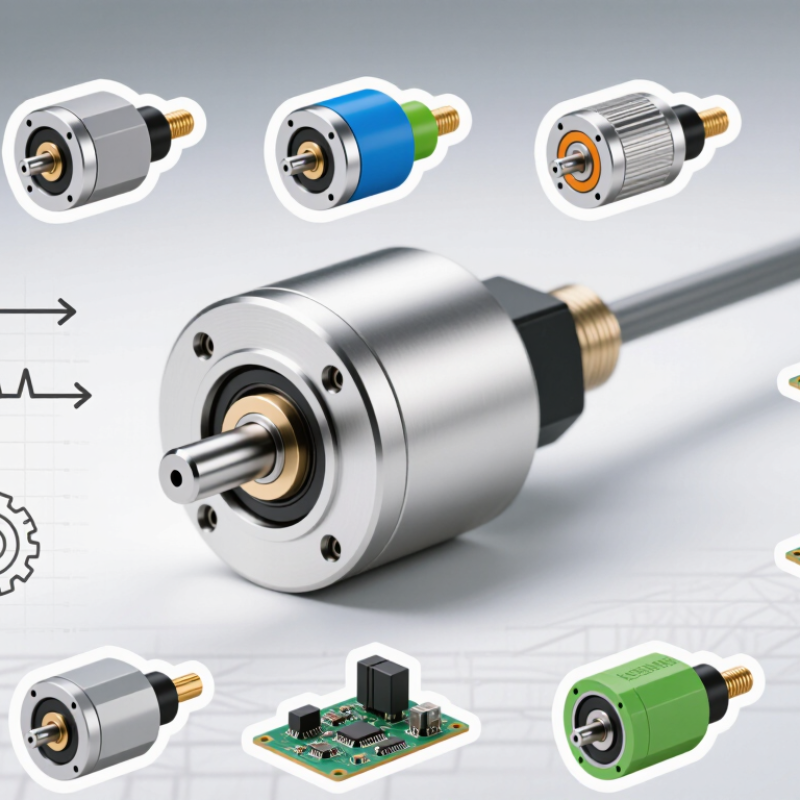
China Top 10 Rotary Sensor Manufacturers?

What Rotary Sensors Are and How They Work

A rotary sensor measures angular position, speed, or direction around a shaft. Inside a compact housing, a sensing element converts rotation into an electrical signal. Incremental encoders produce pulses as a shaft turns; a controller counts them to estimate movement. Absolute encoders assign a distinct digital value to each angular position, even after power returns. Potentiometric sensors work differently: a rotating contact changes resistance and output voltage. Resolvers use electromagnetic coupling to produce signals related to shaft angle. Different mechanisms suit different conditions.

Small parts, precise work.

In a factory, a motor shaft may turn thousands of times while a sensor reports position to a controller. The controller uses that feedback to adjust motion and detect deviations. IFR’s World Robotics 2024 report records 541,302 industrial robot installations worldwide in 2023, highlighting the scale of automated motion systems that depend on reliable position feedback.

The figure describes robot installations, not rotary-sensor sales, so it should not be read as a direct measure of sensor demand.

Selection involves more than resolution.

Engineers also check operating temperature, vibration, electrical noise, shaft alignment, and required output format. A high-resolution sensor can still give poor readings if it is mounted off-center or poorly calibrated. Incremental types may need a reference point after startup; absolute types can preserve position information, but often cost more. There is no universal winner. The right choice depends on the machine, and real installations can be messier than a specification sheet suggests.

Types of Rotary Sensors Made in China

China-made rotary sensors cover several technologies, each suited to different motion and measurement needs. Potentiometric models use a sliding contact and suit simple angle feedback, though wear can limit service life. Hall-effect and magnetoresistive sensors read a rotating magnet without physical contact. Optical encoders use a light source and coded disc for fine position measurement. Inductive sensors and resolvers are common choices where dust, vibration, or temperature challenge optical parts. Incremental encoders track movement; absolute encoders report a distinct position after power-up.

MarketsandMarkets’ 2023 position-sensor report valued the broader global market at about US$5.2 billion and forecast US$7.6 billion by 2028. That figure covers position sensors generally, not rotary sensors alone. It signals wider demand, but does not identify which technology fits a specific machine. In practice, shaft alignment, output format, resolution, and operating temperature matter as much as sensor type. Labels can overlap, so check the measurement method and datasheet rather than relying on a product title.

Tips: For a dusty conveyor, compare sealed magnetic or inductive designs with optical units. Confirm whether the output is analog, incremental, or absolute, and test the sensor across the full rotation range. A bench test can reveal wiring or alignment issues before installation. Do not assume a higher resolution automatically improves control.

China Rotary Sensor Types: Typical Output Interfaces

A technology overview—not a manufacturer ranking. Output options vary by sensor design and model.

Bars indicate whether an output interface is commonly available for that sensor type; they do not indicate quality, accuracy, or market share. Magnetic encoders and Hall-effect angle sensors may offer different interfaces depending on configuration.

Criteria for Selecting Leading Rotary Sensor Manufacturers

When comparing China’s rotary sensor manufacturers, start with the measurement task, not the catalog headline. Check accuracy, repeatability, resolution, and electrical output against your controller’s input range. A sensor used for slow valve movement may need different performance from one tracking a fast motor shaft. Numbers matter.

Ask how each unit is tested and whether test conditions match your application. Look for clear tolerance data, calibration records, and consistent readings across repeated rotations. Inspect the shaft, connector, and housing details, too. Dust, vibration, temperature changes, and side loads can affect service life. A neat specification sheet is not enough. Request a sample and test it on your own equipment.

Production consistency deserves attention alongside technical performance. Ask about incoming material checks, final inspection, and how changes between production batches are controlled. Confirm lead times, available output types, and technical support before placing an order. If the sensor needs a custom shaft or connector, clarify what will be verified before shipment. Price matters, but the lowest quote may leave important test details unclear. I would not treat a single successful sample as proof of long-term reliability; that judgment takes more evidence.

China Top 10 Rotary Sensor Manufacturers? - Criteria for Selecting Leading Rotary Sensor Manufacturers
No. Selection Criterion What to Compare Evidence to Request or Verify Why It Matters
1 Measurement Performance Resolution, accuracy, repeatability, linearity, and hysteresis, assessed separately rather than treated as interchangeable specifications. Datasheets that define each term, measurement conditions, test method, and operating temperature. These characteristics determine whether the sensor can meet the application’s position-feedback requirements.
2 Single-Turn and Multi-Turn Capability Whether the device measures within one revolution or tracks position across multiple revolutions; check the specified measuring range and how multi-turn position is retained. Technical documentation describing measuring range, turn count, and behavior after power loss. Different machine axes need different angular ranges and position-tracking behavior.
3 Output and Communication Interface Available electrical outputs and supported interfaces, such as analog signals, incremental or absolute outputs, SSI, CANopen, or EtherCAT. Interface specifications, wiring diagrams, protocol documentation, and compatibility information for the intended controller. Interface compatibility affects integration effort, data handling, and system architecture.
4 Mechanical Fit Housing dimensions, shaft or hollow-shaft arrangement, mounting pattern, allowable shaft load, and connection options. Dimensioned drawings, installation instructions, and documented mechanical load limits. A suitable mechanical design helps avoid fit, alignment, and premature-wear problems.
5 Environmental Protection Ingress-protection rating, operating and storage temperature ranges, and resistance to vibration, shock, dust, or moisture as required by the installation. Model-specific ratings and test reports. Check that any IP rating is stated for the relevant product configuration. Environmental suitability depends on the actual installation conditions, not on a general product-family description.
6 Electrical and EMC Compatibility Supply voltage, current consumption, protection features, cable requirements, and electromagnetic-compatibility performance. Electrical limits, EMC declarations or test documentation, grounding guidance, and recommended cable specifications. Proper electrical integration can reduce signal errors and improve reliable operation near motors and drives.
7 Reliability and Service Life Specified operating life, bearing or contact design where applicable, permitted operating speed, and maintenance requirements. Published limits, endurance or reliability test details, and warranty terms for the specific model. Reliability affects downtime, maintenance planning, and total cost over the sensor’s service life.
8 Quality Management and Traceability Documented manufacturing controls, inspection processes, calibration practices, and traceability of delivered units. Current quality-system certificates where applicable, sample inspection records, and serial-number or batch-traceability procedures. Documented processes make it easier to assess consistency and investigate quality issues.
9 Customization and Engineering Support Ability to configure shaft, connector, cable, output, or protocol options, and support for integration and troubleshooting. Written configuration options, technical response process, engineering documentation, and sample lead times. Application-specific options and accessible technical support can reduce design and commissioning delays.
10 Delivery, Warranty, and Lifecycle Support Quoted lead time, product-change notification practices, spare-parts availability, warranty coverage, and repair or replacement process. Written quotations, warranty terms, lifecycle-support policy, and documented after-sales service arrangements. Supply continuity and service arrangements matter for production planning and long-term equipment support.

Use these criteria to compare specific models and verify claims with model-level documentation. Requirements and suitable performance levels depend on the application; no universal specification or ranking applies to every rotary-sensor use case.

Profiles of Ten Chinese Rotary Sensor Manufacturers

China’s rotary sensor sector serves robotics, machine tools, packaging lines, and mobile equipment. The International Federation of Robotics reported 276,288 industrial robots installed in China in 2023, underscoring a large automation market—not a direct measure of rotary sensor sales. The ten manufacturer profiles therefore focus on practical capabilities: optical encoders for fine positioning; magnetic encoders for dusty environments; resolvers for high temperatures; Hall-effect sensors for compact drives; and inductive designs for metalworking lines.

Other profiles examine single-turn and multiturn absolute sensors, hollow-shaft models for direct motor mounting, heavy-duty units for vibration, and custom OEM production. Buyers should compare resolution, repeatability, shaft loading, ingress protection, and signal compatibility. Ask for test conditions, not just headline specifications. A stated accuracy may change with temperature or installation.

The profiles also consider calibration records, sample availability, production consistency, and technical support. These details matter when a sensor must fit an existing control system. China’s robotics growth offers useful industrial context, but it does not prove that every supplier meets the same performance level. Some catalog data remains difficult to compare. Requesting a sample test is sensible, though it can add time. Source: IFR, World Robotics 2024.

How to Compare Manufacturers by Performance and Application

China Top 10 Rotary Sensor Manufacturers?

Comparing manufacturers by performance and application requires more than checking a catalog range. Start with the shaft’s actual movement: a slow valve adjustment has different needs from a motor spinning thousands of times per minute. Check measuring range, repeatability, linearity, resolution, and response time. Ask for test conditions, not just headline specifications. A sensor’s stated accuracy may change with temperature, supply voltage, or mounting alignment.

Fit the sensor to its environment. A compact actuator may need a small housing and a simple electrical connection; outdoor machinery may need protection from dust, moisture, vibration, and temperature swings. Compare output types and interface compatibility with your controller before evaluating price. Request samples or documented test results, then check readings across the full rotation, not only at one position. Small details matter. Installation space, cable routing, and shaft coupling can cause problems that a specification sheet will not reveal. This comparison is not perfectly neat: manufacturers may test under different conditions, making figures difficult to compare directly. Record your own application requirements and verify critical claims with practical testing.