What Are the Top Extrusion Shapes in 2026?
Extrusion Shapes are defined by more than their outline. Material, wall thickness, tolerances, and end use all affect which profiles manufacturers can produce efficiently. In aluminum, common choices include solid bars and rods, hollow tubes, angles, channels, T-sections, and custom structural profiles. Each has a practical role: tubes can support lightweight frames, while finned profiles help move heat away from electronic components. Simple shapes are not always the best fit.
Market data offers useful context, but it does not rank individual profiles. Fortune Business Insights estimated the global aluminum extrusion market at USD 92.83 billion in 2024 and forecast growth to USD 141.67 billion by 2032, a projected compound annual growth rate of 5.4%. That forecast signals a substantial market, not proof that one shape will lead in 2026. The report also focuses on aluminum, so its figures should not be treated as representative of plastic extrusion. A shape’s popularity can vary by sector, region, and project requirements. That ranking is imperfect. This guide compares widely used profiles by function, manufacturability, and application, with practical details such as whether a channel suits a mounting rail or a hollow section reduces weight without sacrificing needed stiffness. It is a starting point, not a substitute for checking a specific design with an experienced extrusion supplier.
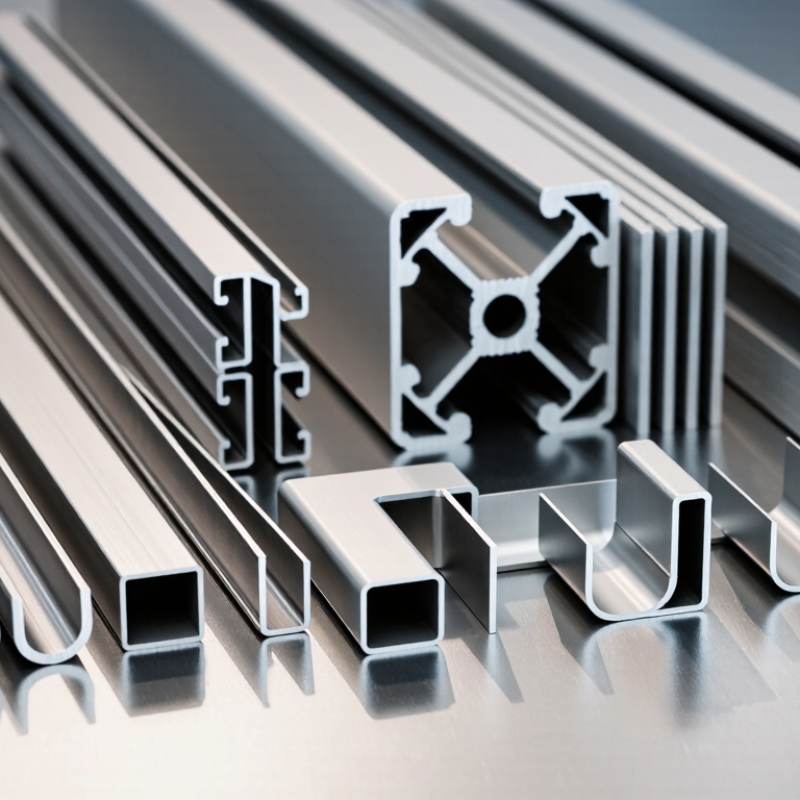
Common Extrusion Shapes and Their Defining Features
What Are the Top Extrusion Shapes in 2026?
Common Extrusion Shapes and Their Defining Features
Extruded profiles take shape as material passes through a die, producing consistent cross-sections along their length. Solid bars and rods have simple, strong forms, often chosen for supports or machined parts. Tubes and hollow sections reduce material use while keeping useful stiffness. Their wall thickness and dimensions need careful specification. The trade-off is weight.
Channels and angles offer open sections that are easy to join or mount. T-shaped profiles can support connections from several directions, while I- and H-shaped beams place material where bending loads often demand it. These shapes are not interchangeable. The right choice depends on load, span, fastening method, and how the part will be made. Custom profiles can combine ribs, grooves, and hollow chambers, but added complexity may raise tooling and inspection demands. A clever cross-section can still be difficult to produce.
Tips: Define the load and attachment points before choosing a shape. Check wall thickness, corner radii, and tolerances with an extrusion specialist. Measure twice. Small details matter. One frequent oversight is designing a profile around its appearance, then discovering that assembly access is poor. Revisit the design with the real installation in mind.
Standard Profiles: Angles, Channels, Tubes, and Bars
In 2026, angles, channels, tubes, and bars remain practical starting points for many extrusion designs. Each shape solves a different structural problem. An angle can brace a frame or support a shelf, while a channel can guide a sliding panel or protect an exposed edge. Their open profiles are easy to inspect, but orientation matters: a channel may resist bending differently depending on how its web faces the load.
Tubes provide a clean outline and useful stiffness with material distributed around a hollow center. Square tubes often fit neatly into frames; round tubes suit applications needing curved connections or rotation. Check wall thickness, corner radii, and joining access before settling on a size. Small changes can affect fit and strength. Bars are simpler, solid profiles used for spacers, supports, and machined parts. They are sturdy, but may weigh more than a hollow section serving a similar purpose.
There is no perfect profile. A common oversight is choosing from an outer dimension alone, then discovering that fasteners or adjacent parts do not fit. Compare load direction, available space, finish, and fabrication needs with a qualified engineer or supplier. Even a neat drawing can miss a real-world clearance. Recheck it.
Specialized Shapes for Industry-Specific Applications
In 2026, the most useful extrusion shapes are designed around specific jobs, not appearance alone. T-slot profiles support adjustable machine frames, guards, and workstations. Their open channels make it easier to attach brackets or reroute cables during a line change. Heat-sink profiles use thin fins to increase surface area around compact electronics. More fins are not always better; spacing and airflow matter.
Hollow and rectangular sections suit equipment frames, vehicle components, and architectural supports where stiffness and weight both count. Custom channels and asymmetrical profiles can guide sliding panels, protect wiring, or fit a narrow enclosure. In food-processing equipment, smooth, accessible surfaces can simplify cleaning. For windows and façades, multi-chamber profiles may help limit heat transfer, though the full assembly determines performance.
A reliable profile starts with its working conditions. Specify load, temperature, exposure, finish, and joining method before settling on dimensions. A wall that is too thin can distort during fabrication; one that is too thick adds material and machining time. Ask for sample sections or prototype tests when fit is critical. It can feel slower. It often prevents a costly redesign. Die complexity, alloy choice, and production volume also affect what is practical, so an attractive drawing may need revision.
Emerging Design Trends in Extrusion Shapes for 2026
What Are the Top Extrusion Shapes in 2026?
Emerging Design Trends in Extrusion Shapes for 2026
Extrusion design is moving beyond standard bars and simple channels. In 2026, expect more application-specific profiles: slim window frames, integrated heat-sink fins, and hollow sections with ribs placed only where loads demand them. These shapes can reduce material use and simplify assembly. The International Aluminium Institute’s 2022 outlook projects global aluminium demand could grow nearly 40% by 2030, reinforcing interest in efficient, lightweight designs. The projection is broad, not a forecast for extrusion profiles alone.
Designers are also combining functions within one profile. A façade section might hold glazing, conceal drainage, and create a thermal break. In transport, hollow, multi-cell sections can balance stiffness with lower weight, though joining and inspection become more demanding. Recycled content and lower-carbon production are influencing specifications, too; profile geometry must still meet strength, finish, and tolerance requirements. Small details matter. A narrow internal corner may complicate die flow, while a generous radius can improve manufacturability. I would not treat every complex shape as progress. Sometimes the smarter design is simply a cleaner section with fewer parts.