
Natural Gas Steam Boiler manufacturers serve hospitals, food plants, laundries, and factories where steady steam matters. Their products may look similar in a catalog. On site, however, burner control, heat-transfer design, water quality, and service access shape daily performance. A boiler room tells the real story: pipe runs, access space, condensate return, and the sound of a burner cycling under load.
Heating educator Dan Holohan’s practical teaching can be summed up this way: “Match the boiler to the building’s actual heat demand.” This is an editorial paraphrase, not a verbatim quotation. It points to a common buying mistake: comparing headline efficiency figures without checking operating conditions. Fuel use, emissions data, turndown range, controls, and maintenance support deserve equal attention. Ask how claimed performance was measured. Details matter.
This overview of top manufacturers worldwide considers product range, engineering capability, documented performance, and support networks. A large name alone proves little. Buyers should verify specifications against their steam pressure, capacity, fuel supply, and operating schedule. They should also ask about parts availability and technician training in their region. Small details can become expensive delays.
No ranking fits every plant. A compact food processor may need fast startup and simple controls; a continuous-process facility may value stable output and redundancy. Even a well-designed boiler can disappoint when water treatment or routine inspection is neglected. That part is easy to underestimate. The comparison ahead offers a practical starting point, not a substitute for a site-specific engineering review.
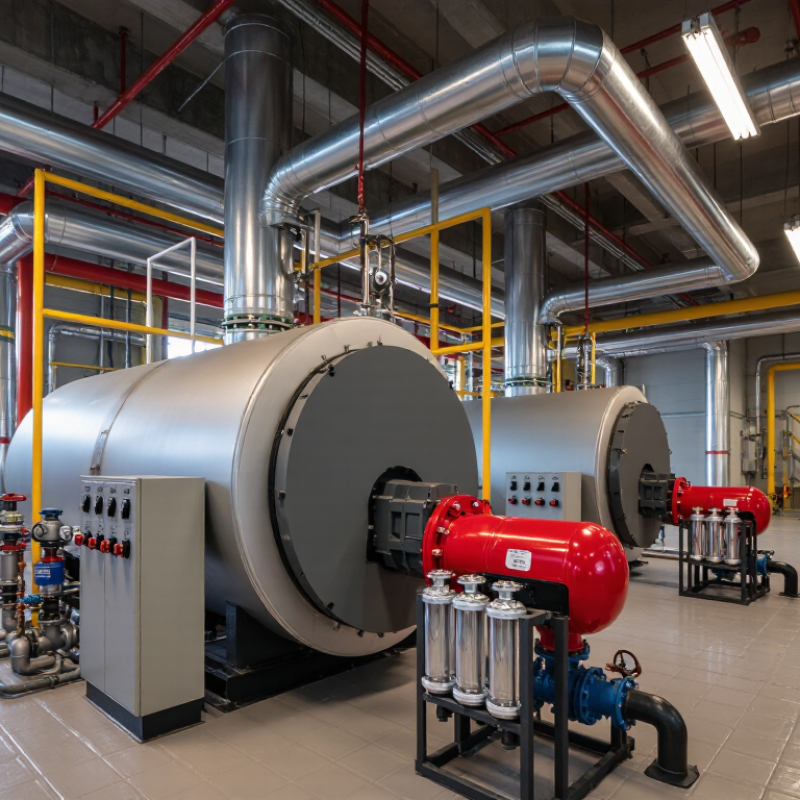
Natural-gas steam boilers burn fuel to heat water and deliver steam for process heating, cleaning, sterilization, and humidity control. The U.S. Department of Energy’s 2002 Steam System Opportunity Assessment estimated that steam systems account for about 30% of energy used in U.S. manufacturing. That scale makes boiler efficiency and correct sizing important. A boiler oversized for its load may cycle frequently and waste fuel.
Fire-tube boilers pass hot combustion gases through tubes surrounded by water. They are often suited to lower-pressure, steady steam demand. Water-tube boilers move water through heated tubes and can serve higher-pressure or larger-capacity applications. Packaged units combine key equipment in a factory-assembled system. The best fit depends on steam pressure, demand swings, available space, and maintenance capability. There is no universal choice.
Core components include a gas burner, combustion chamber, heat-transfer surfaces, steam drum or shell, feedwater system, and controls. Safety valves protect against excess pressure; gauges help operators monitor conditions. An economizer can recover heat from exhaust gases to preheat feedwater. Small details matter. Poor water treatment can cause scale on heat-transfer surfaces, while incorrect burner tuning can increase fuel use. Even experienced operators need to verify actual load patterns before specifying equipment.
Natural gas steam boilers burn fuel in a furnace, sending hot flue gas across water-filled tubes. As the water absorbs heat, it boils; steam then leaves the drum at a controlled pressure. Some applications need saturated steam, while others require superheated steam for higher temperatures. Pressure is not just a number on a gauge. It affects steam temperature and the performance of equipment downstream.
A pressure transmitter signals the burner management system to adjust gas and air flow as demand changes. Feedwater controls maintain drum level, while oxygen sensors can help trim excess air and reduce avoidable stack losses. These loops need regular calibration. Small errors matter. The U.S. Department of Energy’s 2012 Improving Steam System Performance: A Sourcebook for Industry reports that many facilities can identify energy savings of 10–15% through steam-system improvements. That figure covers the wider system, not boiler controls alone. In practice, varying loads, poor condensate return, or a drifting sensor can complicate expected results. Operators should compare pressure, water level, flue-gas readings, and fuel use over time; one reading rarely tells the whole story.
When comparing natural gas steam boiler manufacturers worldwide, evaluate documented performance, not headline efficiency alone. Ask for efficiency at your actual operating load, fuel composition, and feedwater temperature. Request test conditions and independent verification. The IEA’s Energy Technology Perspectives 2023 reports that industry accounts for roughly one-quarter of global energy-related emissions, making fuel use and emissions data meaningful purchasing criteria. Check burner turndown, steam pressure stability, NOx guarantees, and controls compatibility. A polished brochure is not proof. Even strong specifications can be hard to verify.
Safety and service matter over the full operating life. Confirm the pressure-vessel design code, inspection records, material traceability, and conformity with applicable local requirements. Compare warranty exclusions, spare-parts lead times, commissioning support, and technician coverage near the installation site. Ask for references from plants with similar steam demand and water quality. ISO 16528 provides a framework for pressure equipment, but it does not replace local approval or site-specific engineering. One detail is easy to miss: poor condensate return can undermine expected fuel savings.
Tips: Request a heat-balance sheet and an emissions test report at low, typical, and peak loads. Compare annual fuel costs using your own run hours and gas prices. Get assumptions in writing. Then check whether the proposed service plan fits your maintenance team.
Illustrative evaluation framework — suggested assessment weights, not market-research findings or ratings of specific manufacturers.
The weights total 100% and can be adjusted for project needs. Compare documented efficiency and emissions performance under relevant test conditions, applicable certifications, pressure and capacity ranges, safety provisions, service coverage, and lifecycle costs. Verify all claims against technical documentation and local regulations.
Leading Natural Gas Steam Boiler Manufacturers by Region
Regional manufacturers often reflect local fuel access, industrial demand, and service networks. In Asia-Pacific, suppliers commonly serve factories needing compact, high-output units and rapid parts support. Europe’s market places strong emphasis on combustion control, heat recovery, and documented efficiency. North American producers often focus on large process loads, robust pressure equipment, and integration with existing plant systems. These are broad patterns, not guarantees; regional labels can hide meaningful differences between individual factories.
The Energy Institute’s Statistical Review of World Energy 2024 reports global natural gas consumption of about 4,000 billion cubic metres in 2023. North America and Asia-Pacific accounted for substantial shares, supporting distinct manufacturing and service ecosystems. In the Middle East, gas-fired steam systems are also relevant to energy-intensive processing. A manufacturer’s regional presence matters most when technicians can reach the site and critical components are available. Boiler capacity alone tells only part of the story.
Tips: Compare verified efficiency at your actual operating load, not just rated output. Ask for combustion test records, clear maintenance intervals, and local service response times. One detail is easily overlooked: water treatment quality can affect reliability as much as burner selection.
Natural gas steam boilers remain important in food processing, textiles, chemicals, and district heating. They provide steady steam for cooking, drying, cleaning, and production lines. A plant may need steam at a stable pressure throughout a long shift, while demand changes sharply between batches. Proper boiler sizing matters; oversized equipment can cycle frequently and waste fuel.
Efficiency depends on more than the burner. Economizers can recover heat from exhaust gases, while insulation reduces losses from pipes and valves. Operators should track fuel use, steam output, stack temperature, and water quality. Small changes can reveal fouling or poor combustion before performance drops significantly. Details matter. Still, efficiency figures from different manufacturers are not always directly comparable, since test conditions and system boundaries may differ.
Manufacturers are adapting to tighter energy budgets and changing industrial needs. Digital controls can flag unusual operating patterns, but they cannot replace skilled inspection. Hybrid systems, heat recovery, and boilers designed for future fuel flexibility are gaining attention. Their value depends on local infrastructure and the actual steam profile, not marketing claims. Some facilities may find electrification difficult during peak demand; that constraint deserves honest assessment. Buyers increasingly compare lifecycle service, spare-parts access, and commissioning support alongside purchase price. A technically strong boiler can disappoint when maintenance planning is weak.
| Comparison Dimension | Industry Fact or Application | Relevance to Boiler Selection and Manufacturing | Reference |
|---|---|---|---|
| Fire-tube boiler design | Hot combustion gases pass through tubes surrounded by boiler water. Fire-tube units are commonly used for lower- to medium-capacity steam duties. | Often considered for facilities with comparatively steady steam demand and moderate pressure requirements. Capacity, pressure, water quality, and turndown should be checked against the process load. | U.S. Department of Energy (DOE), Steam Systems |
| Water-tube boiler design | Water flows inside tubes while hot combustion gases pass around them. Water-tube designs are used for a wide range of industrial and high-pressure steam duties. | Useful where steam capacity, pressure, or load variation calls for a design suited to the operating conditions. System design and operating controls are as important as the boiler type. | DOE, Steam Systems |
| Common industrial applications | Steam is used for process heating, cleaning, sterilization, humidification, and power generation. Users include food processing, chemicals, pulp and paper, refining, and healthcare facilities. | Manufacturers typically configure equipment around required steam pressure, peak and average demand, operating hours, fuel availability, and site-specific emissions requirements. | DOE, Steam Systems |
| Thermal efficiency assessment | Boiler efficiency depends on fuel input and useful steam output; actual performance is affected by combustion, blowdown, radiation losses, operating load, and maintenance. | Compare proposals using a clearly stated test method, fuel heating-value basis, operating load, and included auxiliary power. A single efficiency figure is not directly comparable if these conditions differ. | DOE, Steam Systems |
| Combustion and excess air | Combustion controls manage the air-to-fuel ratio. Too much excess air can increase stack losses, while insufficient air can cause incomplete combustion and elevated carbon monoxide. | Look for suitable burner controls, commissioning, and routine checks of flue-gas oxygen and carbon monoxide across the expected operating range. | DOE, Steam Systems |
| Natural-gas carbon dioxide factor | The U.S. EPA stationary-combustion factor for natural gas is approximately 53.06 kg CO₂ per MMBtu of fuel input. | This is a fuel-combustion factor, not a boiler-efficiency rating or a full lifecycle emissions figure. Actual fuel use determines a boiler’s direct CO₂ emissions. | U.S. EPA, GHG Emission Factors Hub |
| Heat recovery | Economizers can recover heat from boiler exhaust to preheat feedwater. Condensing heat recovery can also capture heat from water vapor in flue gas when system conditions allow. | Potential savings depend on return-water temperature, exhaust conditions, corrosion protection, operating hours, and the plant’s heat demand. A site-specific assessment is needed. | DOE, Steam Systems |
| Steam-system efficiency | Distribution leaks, poorly insulated lines, inappropriate steam pressure, and ineffective condensate return can waste energy beyond the boiler itself. | Evaluate the complete steam system—including traps, insulation, condensate recovery, and controls—rather than relying only on the boiler’s stated efficiency. | DOE, Steam Systems |
| Electrification trend | Electric boilers and other electric process-heat technologies are options for industrial heat users; their suitability depends on the required temperature, power availability, electricity cost, and emissions profile. | Manufacturers and buyers increasingly assess fuel flexibility and electrical integration alongside natural-gas equipment, especially for sites planning lower-carbon operations. | International Energy Agency (IEA), Industry |
| Hydrogen readiness | Hydrogen combustion characteristics differ from natural gas. Fuel conversion or blending can affect burners, controls, materials, safety systems, and emissions. | Do not assume a natural-gas boiler is hydrogen-ready. Obtain written confirmation of the permitted fuel blend and operating conditions from the equipment supplier and applicable authorities. | IEA, The Role of Hydrogen in the Energy Transition |
| Medium combustion plant regulation in the EU | The EU Medium Combustion Plant Directive applies to combustion plants with a rated thermal input of at least 1 MW and less than 50 MW, subject to the directive’s provisions and exemptions. | Project specifications should account for local permitting and applicable emission limits; requirements vary by jurisdiction, plant size, fuel, and installation date. | European Commission, Medium Combustion Plants |
| Procurement considerations | Key evaluation factors include steam capacity and pressure, turndown, load profile, fuel quality, water treatment, emissions controls, service access, and spare-parts availability. | Use a site-specific technical specification and compare lifecycle cost, commissioning support, maintenance requirements, and compliance documentation—not only purchase price. | DOE, Steam Systems |
Note: This comparison describes equipment types, applications, and industry considerations; it does not rank or identify individual manufacturers or brands. Regulatory and emissions requirements should be verified for the project’s location.
5107 County Road C
Manitowoc, WI 54220
920-726-4526