China Top Pharmaceutical Checkweigher Manufacturers
Choosing among China’s top pharmaceutical checkweigher manufacturers calls for more than comparing machine prices or catalog specifications. A Pharmaceutical Checkweigher verifies product weight on a moving line and can help teams identify out-of-range packs before they reach later stages. Small details matter. A clear display, stable conveyor, and accessible reject mechanism can make daily operation easier. Yet a machine’s stated accuracy alone does not show how it will perform with a specific product, package, or production speed.
This overview introduces practical factors for evaluating manufacturers, including weighing performance, line integration, documentation, operator training, and after-sales support. Ask how testing is conducted and what conditions apply to quoted accuracy. Request relevant technical records, sample evaluations, and references where available. Check whether the supplier can explain installation needs and maintenance intervals in plain terms. These conversations offer useful evidence, though they cannot replace an on-site assessment. Not every production line has the same constraints. A compact bottle line, for example, may need different conveyor handling and reject timing from a pouch line. Manufacturer claims should therefore be reviewed against your actual products and operating conditions. Some specifications can look reassuring on paper. Real production is less tidy. A careful comparison helps buyers shortlist suppliers without treating promotional language as proof, and keeps product quality, reliable operation, and long-term service in view.
Pharmaceutical Checkweighers in China: Purpose, Scope, and Core Applications
China Top Pharmaceutical Checkweigher Manufacturers
Pharmaceutical Checkweighers in China: Purpose, Scope, and Core Applications
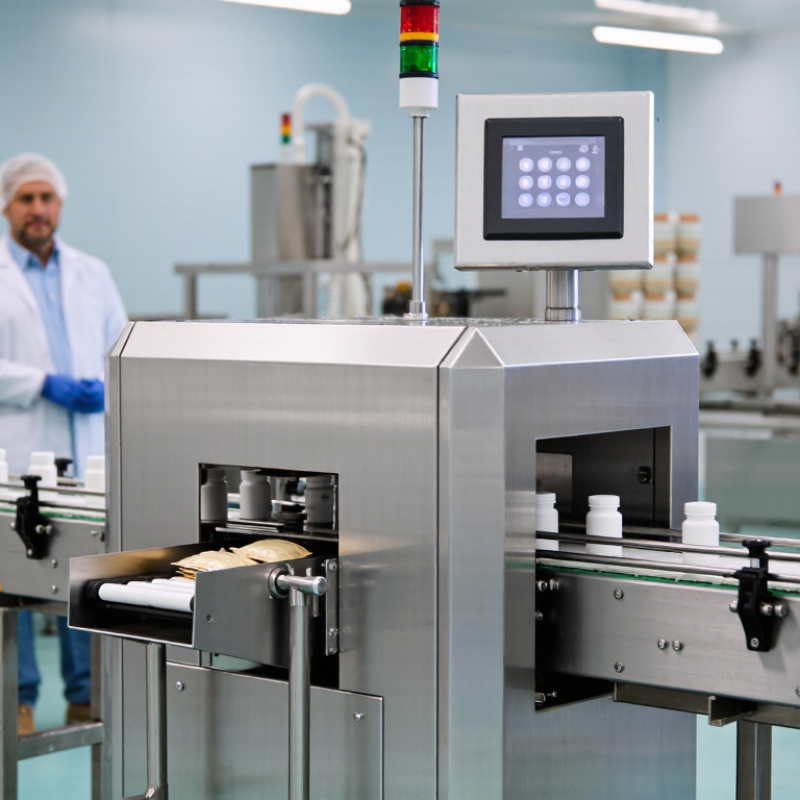
A pharmaceutical checkweigher measures the weight of each package as it moves along a production line. Its main purpose is to flag units outside a configured weight range. Small differences matter. A missing tablet, an underfilled bottle, or an inconsistent carton can affect product quality and traceability.
In Chinese pharmaceutical facilities, checkweighers may be installed after filling, blister packing, or cartoning. A typical system uses a conveyor, a weighing cell, a display, and a reject device. Operators can review weight trends and investigate recurring variation. The equipment does not verify a product’s identity or prove that every dose is correct. Weight is one useful signal, not a complete quality assessment.
Common applications include tablet and capsule bottles, blister packs, sachets, and small cartons. Liquid medicine lines may use checkweighers to monitor filled containers, though container shape and movement can affect readings. Stable conveyor speed, suitable product spacing, and routine calibration help produce dependable measurements.
Setup still takes care. A poorly chosen weight range or rushed line changeover can create false rejects, and that practical weakness deserves attention.
How In-Line Checkweighing Works: 100% Pack-Weight Inspection
In-line checkweighing inspects each pharmaceutical pack as it moves along the production conveyor. A load cell measures its weight without stopping the line. Before inspection, the system uses a stable reference and accounts for the conveyor’s tare weight. Each reading is compared with preset upper and lower limits. The result is immediate. Small details matter.
When a pack falls outside those limits, a reject mechanism diverts it into a separate, controlled collection area. Operators can review rejected packs and investigate recurring patterns, such as a missing leaflet or an inconsistent fill. This does not identify every packaging defect. A pack can meet its weight target and still have another issue, so checkweighing works best alongside other quality checks.
Reliable readings depend on careful setup and routine verification. Conveyor vibration, product movement, and changes in line speed can affect measurements. In practice, teams should test the system with suitable reference weights and review reject data during production. Even a well-tuned line may produce occasional false rejects. That is worth reflecting on: adjusting limits too loosely can hide real variation, while overly tight limits can interrupt production unnecessarily.
How In-Line Checkweighing Works: 100% Pack-Weight Inspection
Each pack is weighed as it moves along the production line. Packs outside the configured weight limits can be automatically rejected. The example below shows sample readings for a 100 g target; the ±2 g limits are illustrative settings, not a universal regulatory standard.
Readings below the lower limit or above the upper limit are flagged for rejection or further inspection. Actual limits and reject settings depend on the product, packaging line, and applicable requirements.
Pharma Quality Context: USP <905> Acceptance Values of 15.0 and 25.0
USP <905> sets Acceptance Value limits of 15.0 at Stage 1 and 25.0 at Stage 2 for Uniformity of Dosage Units. These figures are not checkweigher tolerances. The calculation uses dosage-unit results and variability, with the applicable procedure depending on the product and method. A passing average weight alone does not prove uniformity.
For pharmaceutical checkweighers, the practical role is narrower but important: detect units outside defined mass limits and flag trends before they spread across a batch. On a fast packaging line, vibration, uneven product spacing, and drifting tare values can affect readings. A useful system should be verified under actual operating conditions, with reject function checks and clear records of calibration and alarms. Small details matter.
Weight variation can support the compendial assessment when the permitted mass-variation procedure applies. It cannot replace content testing where that procedure is unsuitable. Manufacturers in China should therefore explain how equipment data are validated, linked to batch records, and protected from undocumented changes. One uncomfortable point remains: a precise display can still create false confidence if the sampling plan or test method is weak. A checkweigher measures mass, not active ingredient.
Comparing China’s Leading Manufacturers: Accuracy, Throughput, and Validation
When comparing China’s leading pharmaceutical checkweigher manufacturers, avoid ranking machines by brochure accuracy alone. OIML R 51:2016 sets requirements for automatic catchweighers, but allowable errors depend on instrument class and test conditions. A stated accuracy figure means little without the test weight, package format, belt speed, and sample size. That matters.
Throughput should be measured as correctly weighed packs per minute, not belt speed alone. Ask manufacturers to run acceptance tests using your actual containers, including the smallest and largest formats. Record missed rejects, false rejects, and weight variation at both nominal and peak speeds. A fast line can still disappoint. Changeovers and vibration can alter results, and these details are easy to overlook.
Validation deserves equal attention. The FDA’s 2011 Process Validation guidance describes a three-stage lifecycle: process design, process qualification, and continued process verification. Apply that framework to checkweighing by documenting installation checks, challenge tests, and routine performance trends. Keep raw test records, not only pass/fail sheets. I would question any comparison that omits product conditions; it may look precise, but it is not yet useful evidence.